Hįdú ɂAssı̨́i – K’inayele

Hįdú ɂAssı̨́i – K’inayele (Now Things, She Carries Them Around) by Laura Grier

Join Laura for their workshop, In Bloom: Lino Printmaking, on April 24th!

Laura Grier’s works in printmaking and word-making are expressions of relationships. In Hįdú ɂAssı̨́i – K’inayele (Now Things, She Carries Them Around), Grier works with TseYǝ́dı́ı (wood), tampons, pads, underwear, takeout containers, plastic beads, pill bottles, and Sahtúgot’ı̨nę Kede (the Bear Lake Language) to make words and patterns that adorn sheets of cotton and the gallery’s walls. These hand-carved wood block prints foil institutional expectations for printmaking by aspiring to be less precious and more useful than fine art prints on paper.

Making with wood and the Bear Lake Language teaches Grier how to recognize the potential for extending and receiving care; asking for and yielding to compromise; and cultivating joy and respect with non-human relations. Within Sahtúgot’ı̨nę Kede, Grier carves out space for their lived experiences as an urban Dene person by crafting words that reflect their reality. For Hįdú ɂAssı̨́i – K’inayele (Now Things, She Carries Them Around) specifically, Grier shares words that describe the floral designs of their textile works, honouring their self-care while confronting the tension they feel about menstruation and its associated waste.

Each design in this new body of work began as experimental drawings made with objects from Grier’s life related to bodies and periods. Grier translated those marks into digital form, then combined them with others into patterns reminiscent of Dene textiles. Though not sewn with beads, this imagery allows Grier to connect with the visual language of Dene craft as a printmaker. The work also creates opportunities for Grier to contemplate the harder-to-recognize relationships in plastic, whose versatility as menstrual products or pill bottles tends to disguise its deep-earth origins. Camouflage is at work in Hįdú ɂAssı̨́i – K’inayele too. As it invites moments of disorientation and discovery, the work asks you to look with fresh eyes on the materials that populate your everyday life.

The RBC Emerging Artist Residency Program is generously sponsored by the RBC Foundation and the RBC Emerging Artist Project.

Laura Grier is a Délı̨nę First Nations artist and printmaker, born in Somba ké (Yellowknife), and raised in Alberta. Through the use of traditional print mediums, they instrumentalize the power of the handmade to reflect political sociology, culture, ecology, and Indigeneity. Responding to lived experiences of urban displacement as a Dene woman through print, Laura’s work is also inspired by the dynamism of Indigenous art practices and uses printmaking as a tool for resistance, refusal, and inherent Bets’ı̨nę́. They hold a BFA from NSCADU (K’jipuktuk) and an MFA from OCAD University (Tkaronto). They have exhibited at Xpace Cultural Centre, Harcourt House, DC3 Art Projects, SNAP Gallery, and ArtsPlace. Laura has received grants and awards for their work, including the Indigenous project grants from the Alberta Foundation for the Arts, Toronto Arts Council, Canada Council for the Arts, and was the 2018 RISE Emerging Artist recipient. They currently reside in Tkaronto.

This exhibition is supported by the RBC Foundation and the RBC Emerging Artist Project.

Complete Freedom

Painters Eleven was the first abstract artist collective in Ontario. They were founded in 1953 at the cottage of artist Alexandra Luke on the Oshawa/Whitby border. The Robert McLaughlin Gallery’s collection began in 1967 when artist Alexandra Luke, a member of the Painters Eleven, donated thirty-seven works from her private collection. Luke’s donation of art included work by all of the members of Painters Eleven and helped to establish the RMG’s unique focus on collecting and exhibiting the work of Painters Eleven. Today, the RMG’s collection of paintings, drawings, sculptures and prints by Painters Eleven has grown to over 1000 works, including works from before and after the Painters Eleven years (1953-1960). The RMG has regular exhibitions featuring works by the group, pulling together different aesthetics or themes.

Rather than having a common philosophy or style, Painters Eleven banded together around their shared desire to support abstraction and exhibit together. As Jock Macdonald noted: “The meaning of our group is the fact that we think alike about creativeness in art and the unity established is our power.” Rather than a manifesto, the group settled on a statement: “There is no manifesto here for the times. There is no jury but time. By now there is little harmony in the noticeable disagreement. But there is a profound regard for the consequences of our complete freedom.” (1955)

Mamanaw Pekiskwewina | Mother Tongues: Dish With One Spoon Territory

Curators: Missy LeBlanc, Erin Szikora

Artists: Lacie Burning, Melody Crowe, Jon Colwell, Sabrina Fontaine, Laura Grier, Jay Havens, Mem Ireland, Sarah MacLeod-Beaver, Sheri Osden Nault, Skye Paul, Matthew Stevens, Michael Tiggelman, Dr. Elder Shirley Williams

Mamanaw Pekiskwewina | Mother Tongues: Dish With One Spoon Territory is the second of four locality specific iterations of the Mamanaw Pekiskwewina project and is presented in tandem with the tour of Taskoch pipon kona kah nipa muskoseya, nepin pesim eti pimachihew | Like the winter snow kills the grass, the summer sun revives it, across so-called Canada. Developed in consultation with region-based Elders, Knowledge Keepers, language teachers, and educators, Mamanaw Pekiskwewina: Dish With One Spoon Territory celebrates and makes visible the traditional and ancestral languages of the lands covered by the Dish With One Spoon treaty, an agreement made between the Anishinaabek, Mississauga, and Haudenosaunee Nations to share the resources and responsibilities of the territory. Mamanaw Pekiskwewina: Dish With One Spoon Territory is co-curated by Missy LeBlanc and Erin Szikora for The Robert McLaughlin Gallery.

E-NOKIICHIGAADEK WIINDIMAAGEWIN

Wenesh ediming pii gdoo-zhigiizhiwewin [1] aawizinok ggashi naasaab miiniwaa gnokomisag? Wenesh ediming zhi-giizhiweng nowewin giin debendiziiwon, e-aawzinok nowewin gaa-miigowin miiniwaa ezhi-jiwong giin biinjina, ezhi-mingowin?

E-ninaasaabsek zhiwe nowewining kina mooshin akiin; nowewin zhinoomaagemgwad e-zhi-kendimong gegoo e-kendimong miiniwaa gdi-kinoomaagonaa waa-zhi mindizoying enso-bebezhig miiniwa aki. E-bi-zhi-koginigoong maanda nowewin debendaaksinok, maanda nowewin gaa-mji-miingowewziying gonda sa nji-gaa-bi-digoshnajig, mooshkin mgoshkaajiikemgwad bimaadiziwin miiniwaa giw bimaadiziiwinwaa mshi-ebi-yaasigwaa. Gda-ni-jiibkenwedaanaa miiniwaa dash gda-ni-mnowaangismi biinjina miiniwaa gdi-noweninaa eni-piichi-maajiibdeg kwii-yoomnaang miiniwaa ni-zhinoomaagwiing waa-ni-zhaaying. Wenesh dash e-zhiwebak pii nindan kidwenan eni-zhinoomaagemgok waa-ni-zhaayin bebkaanak kidwenan dash gewiinwaa gaa-zhinoomaagwaad zhaazhi-gaamaajaajig, nindan dash kidwenan mii-na ni-bnaadak nji-sa maanda waabshkiiyewin?

Mamanaw Pekiskwewina Ezhi-gashiwing Deniiwan gii-ntami zhichigaade oodi zaagijeying zhinoomaagewin oodi Calgary Aapitoweying Mzinigan-gamik pii Binaakwe-giizis-Minidoo-giisoonhs 2019. Gii-zhinoomaadim enji-maanjiining nji-sa Taskoch pipon kona kah nipa muskoseya, nepin pesim eti pimachihew Dibishkoo iwa Bibooni-goon e-zhi-nsigemgok miishkoonsan, maaba niibin giizis neyaab bi-maajiigtoon, maanda zhinoomaagewin oodi TRUCK Nongo e-zhinaagok/ Mzinbiigewin pii Baashkaakodin/Minidoo-giisoonsing 2019. Iwi dash aanji-zhinoomaagewin e-zhinikaadek Maamanaw Pekiskwewina gii-biijigaadeg e-maamowi-zijig mesinibiigejig nji-sa niiwing Anishinaabek nowewin enji-baajig zhiwe Treaty 7 nekeyaa – Nakoda, nehiyawewin, Nitsiipowahsiin, miiniwaa Tsuut’ina – wiinwaa gaa maamowi-sidowaad di-nowewinwaa e-zhchigewaad. Maanda dash zinoomaagewin neyaab gii-miinaawag ntam Anishinaabek zhiwe nekeyaa e-yaajig, e-piichi-mshkooziitoowaad maanda doo-a-kiimwaa zhiwe yaa’ing gegoo mooshkin mwijigaadek nowewin mewzha zhichigewinan e-zhi-jiibkenwiying miiniwaa geyaabi bemjiwong biinjina yaa’ing.

Maanda dash bebaa-zhinoomaading Taskoch pipon kona kah nipa muskoseya, nepin pesim eti pimachihew mompii mzowe-kamik Canada e-szhinikaadek, nindan e-zhi-miiksemgak zhinoomaagewinan aabideg gii-aanji-gnowaabnjigaadenoon; gaawii dash go ngoji pkaan zaagigeying zhinoomaagewin, Mamanaw Pekiskwewina gii-daapinigaade ji-aawong nokiiwin waani-zhiseg nendaasowin zhiwe waa-nji-zhinoomaading nindan. Giw waa-zhitoojig maanda da-aabji’aawan Mamanaw Pekiskwewina – e-wiijiiwed Anishinaabe gekendang maanda zhichigan debendaagozid zhiwe – ji-zhichigaadeg maajiishkaawinan nji-sa e-yaajig zhiwe Anishinaabek miiniwaa ji-mina-maajiishkaamgok di-nowewinwaa. Maanda dash ediming “Zhiwe besha” maanda sa nji-maajiishkaawin ngoji pkaan ni-zhaamgod e-zhi-kenjigaadek miiniwaa zhaagonaashii nsastaagewin nikeyaa ooshime e-zhi-gnoonindowaa Anishinaabek debendaagozijig nongo megwaa miiniwaa mewzha gaa-daajig zhiwe akiing monda e-zhidigok megwaa yaawaad.

Maanda dash bezhig naakinigewin nji-sa maanda Mamanaw Pekiskwewina gonda maanda e-miikigig ji-gnoonaawaad Anishinaaben zhiwe endaajig miiniwaa ji-bzindamoowaad nendowendimoowaad ji-yaamowaad asgaabwitaagewin nji-sa ji-naawseg maanda nowewin ezhi-mzinbiigeng. Ezhi-bigosenjigaadeg maanda zhichigewin ji-aansek gbeying naakonigewin zhiwe enji-nokiichigaadeg maanda gonda e-miikigig zhichigan ezhi-aasgaabichigaadek Anishinaabe naadiziwin enokiijig miiniwaa mesnibiigejig gewii go ji-naakmichigaadeg giigidoowin, ezhi-aansek, miiniwaa gbeying nokiitaadiwin nji-sa Anishinaabek debendaagozijig mooshkin e-piichi mina-daabinigaadek gwek nowewin zhichiganan nji-sa akiing.

Mamanaw Pekiskwewina: Naagan Teg Bezhig Emkwaan minik-ekonaabing aawan eko-niizhing niiwin minik aanji-zhichigeng maanda sa Mamanaw Pekiskwewina zhichigan miiniwaa zhinoomaagaade pii zhinoomaading pipon kona, nepin pesim odi mzowe Canada eshnikaadek. Gii-maajiikigaade dibaajimatoodwaa eyaajig getizijig, ge-kendigig gegoo, Anishinaabemowin ekinoomaagejig. Mamanaw Pekiskwewina: Naagan Teg Bezhig Emkwaan minik-ekonaabing aawan mnaajchigaade miiniwaa zhichigaade ji-waabnjigaadek naadiziwin miiniwaa gegeti nowewin nji-sa minik maanda Naagan Teg Bezhig Emkwaan minik-ekonaabing, naakonigewin zhichigan gaa-zhitoojig Anishinaabek Mississauga, miiniwaa Haudenosanee Mzowe ji-maandookiiyaad kina gegoo eteg miiniwaa naadimaadiwin zhinda ekonaabing. Mamanaw Pekiskwewina: Naagan Teg Bezhig Emkwaan minik-ekonaabing gonda Missy LeBlanc miiniwaa Erin Szikora gii-naabsidoon maanda nji-sa Robert McLaughlin Mzinbiiganag enji-gnowenjigaazowaad.

SHKWAAJ NENDIMOOWIN
[1] Maanda memoonji nakaazong ediming “Ezhi-gashiwing Deniiwan” miiniwaa ‘ntam nowewin’ nji-sa iwi nowewin maaba e-ntami-yaad pii-binoojiiwid gaa-kendang miiniwaa geyaabi ezhi-giigdod endaat. Booj dash go, niibina Anishinaabek mzowe mompii akiing dinkaaznaawaa maanda kidwin “ezhi-gashiwing deniiwan” wii-kidwaad edming nowewin njisa wiinwaa gashiwan miinwaa / maage mewzha nowewin. Maanda zhibiigan gnowaabnjigaade iwi ntam gaa-dibaachigaadek zhiwe kidwin “ezhi-gashiwing deniiwan”

PROJECT STATEMENT

What does it mean when your mother tongue [1] is not the language of your mothers and grandmothers? What does it mean to speak in a language that is not your own, that is not the language that has been passed down and flows through you, sustaining you?

Embedded within languages are entire worlds; language reveals how we know what we know and teaches us how to relate to one another and the land. Being raised with a foster language, a language forced onto us by colonizers, affects all aspects of a life and the lives of those that come after. We take root and are nourished within and by our language as it moves through our bodies and guides us. But what happens when the words that guide you are not the same words that guided your ancestors, but are words instead tainted by imperialism and colonialism?

Mamanaw Pekiskwewina Mother Tongues was first conceived as an offsite exhibition at the Calgary Central Library from October-December 2019. It was presented in concert with Taskoch pipon kona kah nipa muskoseya, nepin pesim eti pimachihew | Like the winter snow kills the grass, the summer sun revives it, an exhibition at TRUCK Contemporary Art in November/December 2019. The original iteration of Mamanaw Pekiskwewina brought together emerging artists from the four Indigenous language groups of the Treaty 7 region—Nakoda, nēhiyawēwin, Nitsiipowahsiin, and Tsuut’ina—who incorporate their ancestral languages into their practice. The exhibition gave space back to the First Nation communities of the area, while asserting that the Indigenous lands that we occupy carry specific language traditions that root us to this land and still flow through us.

For the tour of Taskoch pipon kona kah nipa muskoseya, nepin pesim eti pimachihew across so-called Canada, the relationship between the exhibitions had to be reimagined; rather than a specific offsite exhibition, Mamanaw Pekiskwewina has been adapted to act as a framework of engagement for right relations to the localities of each of the tour locations. Each of the host organizations will utilize the Mamanaw Pekiskwewina—aided by an Indigenous Assistant Curator who has ties to the region—to develop programming that engages with the local Indigenous community and their language revitalization efforts. The definition of ‘local’ for this project has moved away from civic borders and the colonial understanding to one that is more region based and defined in consultation with the Indigenous people that currently and historically reside on the land the host organizations occupy.

One of the main intentions of the Mamanaw Pekiskwewina is for the host organization to engage with the local Indigenous community and be responsive to their needs when it comes to supporting language revitalization efforts through art. The hope is that this engagement will spark long-term institutional change with the host organization by supporting Indigenous cultural workers and artists as well as building a dialogical, reciprocal, and sustainable relationship with the Indigenous community at-large while taking into account the specificity of the language traditions of the land.

Mamanaw Pekiskwewina: Dish With One Spoon Territory is the second of four locality specific iterations of the Mamanaw Pekiskwewina project and is presented in tandem with the tour of pipon kona, nepin pesim across so-called Canada. Developed in consultation with region-based Elders, Knowledge Keepers, language teachers, and educators, Mamanaw Pekiskwewina: Dish With One Spoon Territory celebrates and makes visible the traditional and ancestral languages of the lands covered by the Dish With One Spoon treaty, an agreement made between the Anishinaabek, Mississauga, and Haudenosaunee Nations to share the resources and responsibilities of the territory. Mamanaw Pekiskwewina: Dish With One Spoon Territory is co-curated by Missy LeBlanc and Erin Szikora for The Robert McLaughlin Gallery.

END NOTE
[1] The most common usage of the terms ‘mother tongue’ and ‘first language’ refer to the language that a person first learns during childhood and still speaks at home. However, many Indigenous groups around the world use the term ‘mother tongue’ to refer to the language of their mothers and/or ancestral language. This text observes the latter usage in reference to the phrase ‘mother tongue’.


Conversations on Ezhi-gashiwing Deniiwan

Conversations on Ezhi-gashiwing Deniiwan: Part 1

January 29, 2022 1:00 PM – 2:30 PM

A conversation with Laura Grier, Matthew Stevens, and Melody Crowe, moderated by Erin Szikora.

Conversations on Ezhi-gashiwing Deniiwan: Part 2

February 12, 2022 1:00 PM – 2:30 PM

A conversation with Lacie Burning, Sarah MacLeod-Beaver, and Dr. Elder Shirley Williams, moderated by Missy LeBlanc.

Embedded within languages are entire worldviews. They shape the way we consider ourselves, our environment, and our relationship to those around us. Within so-called Canada there are over 60 distinct Indigenous languages, however, only three are expected to survive the next 100 years—nēhiyawēwin, Anishinaabemowin, and Inuktitut [2]. Despite this dire situation, Indigenous people across this land now known as Canada are taking up the fight to revive and preserve their mother tongues.

Please join us January 29th and February 12th for Conversations on Ezhi-gashiwing Deniiwan, a two-part series exploring the importance of Indigenous languages across Dish With One Spoon Territory. Hear from artists, language teachers, and community organizers who are at the front lines of language revitalization work in our communities.

END NOTE
[2] Gessner, Suzanne and Lorna Wanosts’a7 Williams. Indigenous Languages Recognition, Preservation and Revitalization: A Report on the National Dialogue Session on Indigenous Languages: Abridged Version. Brentwood Bay, BC: First People’s Cultural Council, 2017.


Community-Informed Murals

June 1, 2022 – October 29, 2022

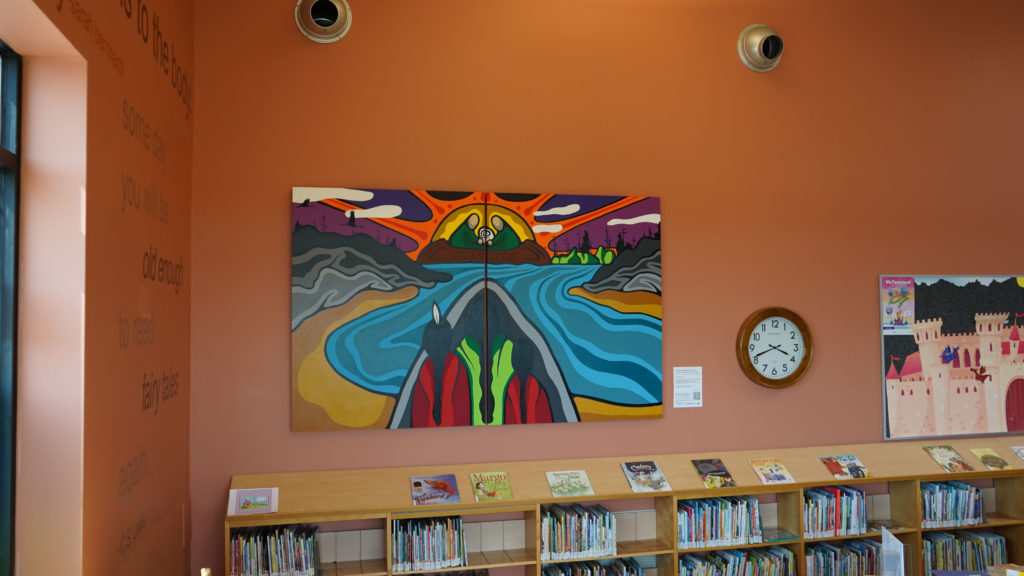
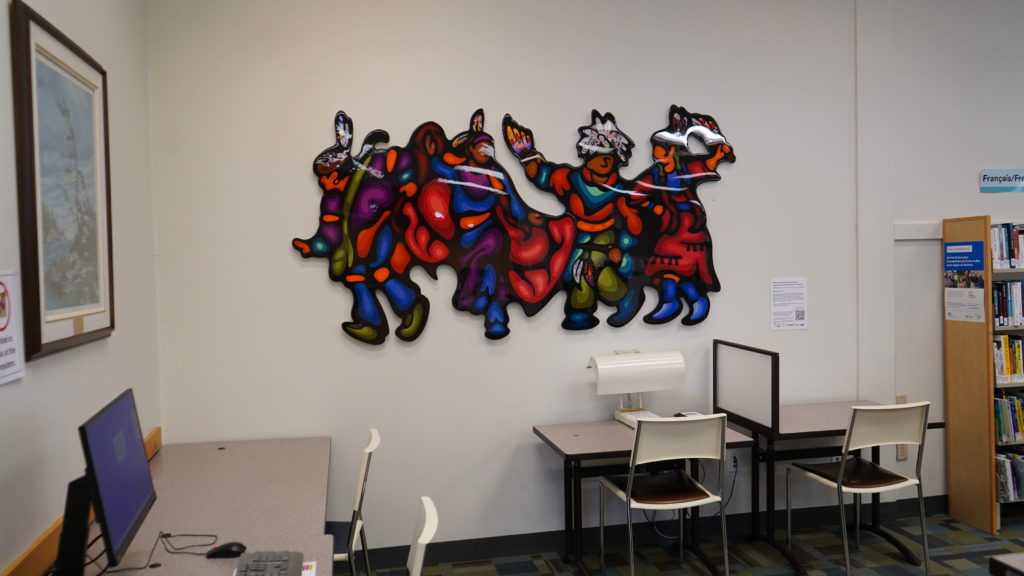
We are pleased to present two community-informed murals by artists Jon Colwell and Jay Havens this summer from June 1st to October 29th at the Delpark and Jess Hann branch libraries. The murals were developed in consultation with local students and Indigenous community members, reflecting the vibrancy and diversity of Oshawa’s Indigenous community, increasing Indigenous visibility and representation in public spaces across the city.

Jon Colwell’s mural on view at Oshawa Public Libraries – Delpark Homes Centre Branch, 1661 Harmony Rd. N., Oshawa.

ABOUT THE ARTIST

Jon Colwell is a self-taught painter and digital artist with a lifetime of artistic practice. He resides on Scugog Island and is a proud member of the Missisaugas of Scugog Island First Nation. The main inspirations for his work include street art, graffiti, vinyl toys, punk rock, tattoos, and skateboarding.

This mural was designed in consultation with members of Bawaajigewin Aboriginal Community Circle.

Jay Haven’s mural on view at Oshawa Public Libraries – Jess Hann Branch, 199 Wentworth St. W., Oshawa.

ABOUT THE ARTIST

Jay Havens (he/him/they) is a multi-media 2Spirit artist, educator, and collaborator of Kanien’keha’ka and Scottish Canadian ancestry. Havens was born on Haudenosaunee Territory known as the Haldimand Tract and raised on Unceded Sto:lo and Musqueam lands close to Vancouver, Canada. He is a proud citizen of the Mohawk, Bear Clan from Six Nations of the Grand River.

This mural was designed in consultation with Grade 7-8 students from All Saints Catholic Secondary School. Their drawings can be seen in the feathers of the dancers.


Story and Song: Intro to Anishinaabemowin with Melody Crowe

June 18, 2022 10:30 AM – 11:30 AM

Join us virtually or in-person at Oshawa Public Libraries – Delpark Homes Centre Branch on Saturday, June 18th for a morning of stories and songs with Anishinaabekwe Melody Crowe. Learn the Anishinaabemowin names for the animals living around us. This event is hybrid with limited in-person capacity. To participate in-person, please email Erin Szikora at [email protected]. To participate virtually, please register with the link below. Each participant will receive a printable colouring book. This event is for all ages and is presented in partnership with Oshawa Public Libraries.

We invite you to download a free printable copy of our Story and Song: Anishinaabemowin Colouring Book illustrated by local Indigenous artists Sabrina Fontaine, Mem Ireland, Sheri Osden Nault, Skye Paul, and Michael Tiggelman. Anishinaabemowin translations provided by Melody Crowe.


Mamanaw Pekiskwewina | Mother Tongues: Dish With One Spoon Territory is presented in partnership with TRUCK Contemporary Art.

We acknowledge the support of the Canada Council for the Arts and the Ontario Trillium Foundation for this project.

Canada council logo

How to Give Ghosts a Sunburn

How to Give Ghosts a Sunburn by Florence Yee

Exhibition: October 30 – December 5, 2021

Join us for an Interactive Artist Talk on Zoom with Florence Yee on Tuesday, November 9, 2021 at 6-7pm.

In this exhibition, Florence Yee presents recent embroidery and text-based artworks that dissect the motives, values, and assumptions that produce public monuments. Drawing on commemorative methods like bronze casting and photography, Yee recontextualizes experiences from their own life to create works that favour process over completion, uncertainty over authority, and consensual recognition over exploitation.

The exhibition’s title reveals a few important things about Yee’s work, including a recurring theme in their practice: futility. Without skin, sunburns are likely a nonissue for ghosts; in this context, How to Give Ghosts a Sunburn reveals Yee’s skepticism of monument-making itself. Nevertheless, the ‘how-to’ title gives the unmistakable impression that this work seeks an approach to monument-making despite these doubts. It also reveals the type of monument Yee is after, one that, through close proximity and searing attention, proves the existence of something immaterial or gives temporary shape to that which is hard to define.

In two of the works, Yee has embroidered the word “proof” across the surface of two images. One is of the Anti-Displacement Garden in Toronto’s Chinatown and the other is a moment of queer intimacy. The watermark designates these works as prototypes, but it also indicates Yee’s desire for the series to be read as evidence of small, but vital gestures: in this case, acts of resistance to gentrification and queer love respectively. Other works explore how memories can fade or spread like a virus, and another posits whether multitudes can be held within commemorative acts. How to Give Ghosts a Sunburn assembles these recent ruminations and invites audiences to consider their relationship to these and other monuments to memory.

The RBC Emerging Artist Residency Program is generously sponsored by the RBC Foundation and the RBC Emerging Artist Project.
Florence Yee is a visual artist and recovering workaholic based in Tkaronto/Toronto and Tiohtià:ke/Montreal. Their practice uses text-based art, sculpture, and textile installation through the intimacy of doubt. Their work has been exhibited at the Museum of Contemporary Art (2021), the Art Gallery of Ontario (2020), the Textile Museum of Canada (2020), and the Gardiner Museum (2019), among others. Along with Arezu Salamzadeh, they have co-founded the Chinatown Biennial in 2020. They obtained a BFA from Concordia University and an MFA from OCAD U.

This exhibition is supported by the RBC Foundation and the RBC Emerging Artist Project.
Taskoch pipon kona kah nipa muskoseya, nepin pesim eti pimachihew | Like the winter snow kills the grass, the summer sun revives it

Taskoch pipon kona kah nipa muskoseya, nepin pesim eti pimachihew | Like the winter snow kills the grass, the summer sun revives it features seven Indigenous artists who create work in an Indigenous language from each of the major geographic regions of what is now known as Canada—Anishinaabemowin, Komqwejwi’kasikl, Michif, nēhiyawēwin, Nitsiipowahsiin, Tāłtān, and Uummarmiutun. The exhibition celebrates and centres Indigenous language revitalization and ways of knowing. Taskoch pipon kona kah nipa muskoseya, nepin pesim eti pimachihew aims to address and initiate a discussion on how Indigenous languages intertwine with Indigenous epistemologies and how the dormancy and extinction of Indigenous languages leads to a hindrance of culture and knowledge. Bringing together emerging and established Indigenous artists based in so-called Canada, the exhibition gives space back to those artists whose practices deal with Indigenous languages in each of their visibilities, vulnerabilities, and regional voices.

Taskoch pipon kona kah nipa muskoseya, nepin pesim eti pimachihew Like the winter snow kills the grass, the summer sun revives it is presented alongside Mamanaw Pekiskwewina Mother Tongues: Dish With One Spoon Territory.

Taskoch pipon kona kah nipa muskoseya, nepin pesim eti pimachihew | Like the winter snow kills the grass, the summer sun revives it is curated by Missy LeBlanc and is organized and circulated by TRUCK Contemporary Art.

We acknowledge the support of the Canada Council for the Arts and the Ontario Trillium Foundation for this project.

Canada council logo

a fervid surfacing

a fervid surfacing by Joy Wong

Exhibition: September 14 – October 24, 2021

Join Joy for an artist talk and workshop on October 2nd at 2 PM!

Across cultures, time, and geographic borders, people have used methods of fermentation to make foods more digestible, delicious, and longer lasting. As the RBC Emerging Artist in Residence at the RMG, Joy Wong has been preoccupied with fermentation. Their new work adopts these practices as a framework for critiquing society’s reverence for purity and fear of contamination, and for asserting that bodies, borders, and cultures are porous, rather than impenetrable.

To create the work in a fervid surfacing, Wong turned to SCOBYs, the colonies of bacteria and yeast that transform sweetened tea into tart kombucha. The artist prepared several batches of kombucha in vessels of assorted shapes and sizes to grow and harvest the slippery, fleshy skins that form in the fermenting tea. Wong dried the SCOBYs on different surfaces, which have imprinted the skins with various textures; the woven pattern of nets reappears throughout the installation. Once drippy and flabby, many of the skins are now rigid and brittle. Others are distinctly gruesome in the way they drip and languish on copper supports. These (net)works and Wong’s embellishments in paint highlight the artist’s interest in origins and the factors that shape how people and places relate to one another. Visually, they challenge the idea that perfection or purity in culture, or in ourselves, is possible, let alone desirable.

Wong also uncovers metaphors for human migration and experiences of living away from one’s motherland. Like other fermented foods, kombucha relies on a starter and the exclusion of other bacteria in the culture. Commonly referred to as a mother, a starter SCOBY can yield numerous batches of kombucha, producing with each fermentation additional SCOBYs for yet more batches. Echoing the complexity of cultural inheritance, access to an original SCOBY eventually becomes impossible to trace. Wong is drawn to the way these processes shed light on the settlement of people in colonized lands, especially the structures that reinforce desirability and belonging for certain cultures while actively rejecting others. a fervid surfacing bears these realities and invites viewers to consider how we are each embedded in the fermentation space and what responsibilities that truth bestows.

The RBC Emerging Artist Residency Program is generously sponsored by the RBC Foundation and the RBC Emerging Artist Project.

The artist would like to thank the Ontario Arts Council for supporting this project.

Joy Wong (she/they) is an interdisciplinary artist based in Tkaronto, with Cantonese immigrant settler ancestry. She works in painting, print media, poetry, and sculpture. Their practice focuses on the intersections of disgust and beauty, decay and decadence, and connects material investigations with the shifting physicality of a queer and racialized body. She obtained her BFA from York University with a double major in Visual Arts and Creative Writing and her MFA from Western University where she received a SSHRC grant for her research. Wong was a finalist for the 2018 RBC Canadian Painting Competition and was the 2019 Pope Artist in Residence at NSCAD.

This exhibition is supported by the RBC Foundation and the RBC Emerging Artist Project.

Undeliverable

Co-presented by Tangled Art + Disability and The Robert McLaughlin Gallery

RMG: September 18, 2021 – February 13, 2022
Tangled Art + Disability: September 17 – October 29, 2021

Undeliverable is a continuation of artist Carmen Papalia’s curatorial practice. Envisioning curation as a form of care, the exhibition brings together six artists from the Mad, Deaf and disability community, Vanessa Dion Fletcher, Chandra Melting Tallow, Jessica Karuhanga, jes sachse, Aislinn Thomas, and Carmen Papalia with Heather Kai-Smith, re-envisioning the museum around the demands and desires of the disabled body/mind. Presented across two spaces – Tangled Art + Disability and The Robert McLaughlin Gallery – the exhibition features ambitious new work that challenges institutional structures and centres mutual accountability.

Kindly note that both the RMG and Tangled Art + Disability are scent free spaces. In order to remain respectful of individuals who may have sensitivity to certain scents or smells, we would like to ask all visitors to help us in creating a fragrance free environment that everyone can enjoy.

Interested in learning more about sensitivity to scents and fragrances? Head over to our Instagram feed for a Takeover by artist Aislinn Thomas that shares more information about how you can help make public spaces more accessible and safe for all those who experience barriers from the toxicants that are in so many personal care, cleaning, building, and fragrance products.

About the Curator and Artists

Carmen Papalia is an artist and disability activist who uses organizing strategies and improvisation to navigate his access to public space, art institutions, and visual culture. His socially-engaged practice expresses his resistance of support options that promote ableist concepts of normalcy, like white canes and other impairment-specific accommodations that only temporarily bridge barriers to participation in an otherwise inaccessible, policy-based system. Papalia designs experiences that invite participants to expand their perceptual mobility and to claim access to public and institutional spaces. Papalia’s walks, workshops, and interventions are an opportunity to model new standards and practices in the area of accessibility.

Heather Kai Smith is an artist who currently lives and works in the unceded Coast Salish Territory known as Vancouver. She completed her MFA at the Emily Carr University of Art and Design (2017), and her BFA in Drawing from the Alberta College of Art and Design (2009). Her current practice explores the potential embedded within archival images of protest, collectivity, and intentional communities activated through drawing, observation and iteration. Rooted in the practice of drawing, her work has lent itself to projects in animation, printmaking, and installation.

Jessica Karuhanga is an African-Canadian artist who works through writing, video, drawing and performance. She has presented her work at The Bentway, Toronto (2019), Nuit Blanche, Toronto (2018), Onsite Gallery at OCAD, Toronto (2018), Museum London, London (2018), Goldsmiths, London, UK (2017) and Art Gallery of Ontario, Toronto (2016). Her writing has been published by C Magazine, Susan Hobbs Gallery and Fonderie Darling. She has been featured in i-D, DAZED, Visual Aids, Border Crossings, Toronto Star, CBC Arts, filthy dreams, Globe and Mail and Canadian Art. She earned her BFA from Western University and her MFA from University of Victoria. She lives and works in Toronto, Canada.

Vanessa Dion Fletcher graduated from The School of the Art Institute of Chicago in 2016 with an MFA in performance, and has exhibited across Canada and the US, including Art Mur (Montreal), Eastern Edge Gallery (Newfoundland), The Queer Arts Festival (Vancouver), and Satellite Art Fair (Miami). Her work is in the Indigenous Art Centre (Gatineau, Quebec), Joan Flasch Artist Book collection, Vtape, and Seneca College. Vanessa is supported by the City of Toronto Indigenous partnerships fund as artist in residence at OCAD University for 2019.

Aislinn Thomas is an interdisciplinary artist whose practice includes video, performance, sculpture, installation, and text. She culls material from everyday experiences and relationships, creating work that ranges from poignant to absurd, and at times straddles both. Her recent works explore the generative nature of disability while pushing up against conventional access measures. Aislinn is a settler of Ashkenazi and British descent. She currently lives and works near the Grand River, on land promised to the Six Nations.

Chandra Melting Tallow is an interdisciplinary artist, musician and writer of mixed ancestry from the Siksika Nation. Their practice confronts the ghosts of intergenerational trauma and their relationship to the body – utilizing both humor and surrealism to subvert oppressive structures of power. They have exhibited across Turtle Island as an installation, sound and performance artist.

jes sachse is an artist, writer and performer whose work addresses the negotiations of bodies moving in public/private space and the work of their care. Their work & writing has appeared in NOW Magazine, The Peak, CV2 -The Canadian Journal of Poetry and Critical Writing, Mobilizing Metaphor: Art, Culture and Disability Activism in Canada, and the 40th Anniversary Edition of Our Bodies, Ourselves. Jes presently lives in Toronto.

Image Description:
Relative Gradient by Vanessa Dion Fletcher. A large, thin circle is made of porcupine quills folded back and forth in a zigzag pattern. The colours of the quill embroidery form a gradient of warm reds, pinks, yellows, browns and whites.

Recent Acquisitions: Abstraction

The foundation of the RMG’s Permanent Collection was an initial donation of 37 works by Alexandra Luke in 1967. This gift set the original focus on Painters Eleven and contemporary Canadian Art, which continues to shape our collecting priorities today. Over the years, the Collection has grown to include nationally significant works of modern Canadian abstraction, the largest holding of Painters Eleven in the world, and an expanding collection of contemporary art. These areas will continue to be enhanced alongside an intention to collect historically excluded artists to reflect a more holistic, diverse, and equitable and reflective history of Canadian art.

This exhibition features recent acquisitions to the Permanent Collection from the past five years, focusing on works that tell the ongoing history of abstraction in Canada. Included in the exhibition are recent acquisitions of works by Painters Eleven, early examples of important Canadian modernism, and contemporary abstract paintings. Abstraction is an important part of the RMG’s story, and this exhibition highlights our efforts to expand and strengthen this part of our history.

Primary Structures

Bowmanville-based artist Ron Eccles’ abstract paintings draw inspiration from a deep sense of place. Rooted within this community, Eccles is inspired by his frequent drives along the shoreline of Lake Ontario from Bowmanville to Port Hope, enjoying the patterned farmland, weather changes, and seasonal colours. His reflections on time, geography, and light manifest in his geometric and structured abstract paintings.

With a prolific career spanning more than five decades, this exhibition focuses on a series of recent work called “White Line Compositions” and includes additional works created within the last fifteen years. Eccles is trained as a printmaker, which informs his painting process and allows him to create simplicity from complex processes, skillfully building layers within his work. Often working on more than one painting at a time, he begins by grounding the painting in blocks of colours, adding different tones to prevent flatness and create transparency and brilliance. A good example of this is Signal Warning (2020), where the red diptych seems to emit light from the wall. After colour, Eccles begins to build structure with white lines, allowing shapes and forms to bleed through, such as in works like River Ice (2020) or North Northwest (2019). While both titles of these works suggest landscapes, they are not representational works; instead, they conjure up feelings, moods, and recollections of a landscape. These connections to nature and memory are not clear to Eccles in the early stages of his process, and it is only after he lays down a primary structure of colour, line, and form that something cues his memory and a subject is realized. As Eccles says: “The painting process feeds you as much as you feed it, it tells you what to do.”

Born in Oshawa, Ron Eccles studied art at the Ontario College of Art (1967), the University of Guelph (B.A., 1970), and the University of Iowa (M.A., 1972). During this time he specialized in printmaking, studying under Frederick Hagan, Walter Bachinski, Gene Chu, and Mauricio Lasanky. In 1972, he moved to Peterborough where he taught drawing at Sir Sandford Fleming College, and would go on to teach printmaking at the Ontario College of Art and the University of Guelph. His work can be found in private, corporate and public collections including the Art Gallery of Peterborough, Blackwood Gallery, Cedar Rapids Museum of Art (Iowa, USA), The Robert McLaughlin Gallery, Canada Council Art Bank, and the Art Gallery of Guelph. His studio and his home are located in Bowmanville, where he lives with his wife and fellow artist, Jane Eccles.

Can I Play Outside?

Join us for a Live Artist Talk + Drawing Event with Jaspal Birdi on February 24, 2021 from 12:00PM -1:00PM.

Using her smartphone, laser printers, and paint, Jaspal Birdi plays with colour and technical glitches to make large photo-based works. In this exhibition, she uses photos from her phone’s camera roll to explore the nature of memory, the interplay between physical and virtual worlds, and the potential for audience interaction in collaborative artmaking.

To make one of her works, Birdi manually overrides the low-ink warnings from her printer to create an ethereal copy of a chosen image. She scans the printed image back into her computer, then prints a second, enlarged copy that is broken into a grid, like tiles or oversized pixels. Piece by piece, Birdi transfers the image to various surfaces with gesso before removing the paper and using paint to further embellish the final image with her memories and interpretations. In this case, the images are affixed to emergency blankets, mirrors, and the gallery wall. These efforts between artist and machine make images that are wholly transformed. Exaggerated, embellished, and missing details, the copies are not unlike memories, which also tend to be altered by their own retrieval.

Can I Play Outside? is particularly concerned with the interactions that take place through digital screens, which play an active role in framing and constructing perceptions of self and others. Think about your own camera roll and the images you may make or encounter online. What sorts of stories do these photos tell? What is remembered and what is forgotten? Alongside these questions, Can I Play Outside? captures the artist’s bid for spontaneous and curious fun. Birdi invites you to add your personal memories and interpretations to the work using a digital drawing app. The multiple versions and layers of this living artwork will mimic the artist’s process of assembling pieces into a whole and will allow audiences to generate a picture that is multi-dimensional, constantly changing, and reflective of collective experiences.

Jaspal Birdi is a Canadian artist who combines photography and painting by experimenting with contemporary technologies. Born in Toronto, Canada 1988, Birdi completed her BFA in drawing and painting from OCAD University 2010, a Masters in Arts Management from Istituto Europeo di Design 2013, and a Specialization in Curating Contemporary Art from Venice School of Curatorial Studies 2016. She is the recipient of the Arte Laguna Solo Exhibition Prize in 2013, as well as the 2017/18 Fondazione Bevilacqua La Masa Artist Residency Fellowship, during which she also received the BLM Stonefly Art Award. In 2017 Birdi co-curated the exhibition “Command-Alternative-Escape” for the opening week of the Venice International Art Biennale. During the 2018 Berlin Art Week, her works were presented in “Transferred Recall,” a curated solo exhibition. Currently, Birdi is a 2020 Visual Arts Fellow for the Fondazione Culturale SanFedele Art Prize.

This exhibition is supported by the RBC Foundation and the RBC Emerging Artist Project.