[envira-gallery id=”8187″]
[envira-gallery id=”8187″]
Opening Reception: Saturday, October 5 2PM – 4PM
Coming to the opening reception from Toronto? We have organized a bus to bring you to and from the opening! Pick up: in front of OCADU at 1:00PM at 100 McCaul Street and will return to OCADU for 4:30. To reserve a spot on the bus: RSVP to [email protected].
For over 40 years, artists Carole Condé + Karl Beveridge have been creating urgent and insightful work that challenges the status quo and brings to light the important issues facing our time. With unwavering attention and unapologetic political analysis, Condé + Beveridge’s work continues to explore the social and environmental impacts of globalization, racial inequality, class struggle, gendered labour divisions, precarity, and the complex struggles of consensus building. In tandem to this practice, they have worked collaboratively with union members and fellow artists, bringing the labour movement and art world into dialogue and in doing so, have transformed them both.
This exhibition presents the photo series Oshawa: A History of Local 222 (1982-83), a comprehensive body of work that traces the history of the autoworkers union in Oshawa from its formation in 1937 through to the mid-1980s. To produce the work, Condé + Beveridge spent two years interviewing and working with members of the Local 222 Retirees Committee. The resulting work, uses intricately staged tableaux to narrate the workers struggle from the perspective of women working in the plant and highlights gender-specific inequalities, including the fight for married women to be able to work and the inclusion of women in the union.
Looking back over the past 35 years since this series was made, we can see the reversal of many hard-won rights, the slow erosion of jobs and the waning strength of the union. With the threat of General Motors of Canada closing the Oshawa plant in January 2020, Condé + Beveridge have returned to work with members of the Local to create a final image in the series. The large-scale photomural pictures members of the union leadership confronting corporate executives and politicians as they stage a burial for the jobs that will be lost at the plant. Working collaboratively with current members of the union, the piece opens up new possibilities for cooperation, solidarity and artistic production, blurring the distinction between art and work, and aesthetics and politics.
Carole Condé and Karl Beveridge
Canadian artists Carole Condé and Karl Beveridge moved to New York City in 1969, and soon were at the centre of the burgeoning conceptual art movement. In 1975, they joined the Art & Language journal The Fox (with Joseph Kosuth and Ian Burn) and picketed the Whitney Museum of Art to protest its lack of inclusion of women artists and artists of colour, while critiquing the apolitical minimalism of Donald Judd. This ferment culminated in a major museum show, It’s Still Privileged Art, at the Art Gallery of Ontario in 1976, just prior to the artists’ return to Toronto in1977.
By the late 1970s, Condé and Beveridge drew a focus on various issues that were urgent within the trade union movement. Their method of working dialogically with their subjects was invented for the landmark 1981 project Standing Up, and has been refined in numerous subsequent collaborations. In the past three decades, over fifty solo exhibitions of Condé and Beveridge’s work have been presented at major museums and art spaces on four continents, including: the Institute of Contemporary Art (London, UK); Museum Folkswang (Germany); George Meany Centre (Washington); Dazibao Gallery (Montreal); Centro Cultural Recoleta (Buenos Aires); Art Gallery of Edmonton; and the Australian Centre for Photography (Sydney).
Equally, and congruent with the artists’ commitment to accessibility, their work has been displayed in a host of non-art and public settings, such as union halls, billboards, bus shelters and bookworks. The artists continue to work and live in Toronto.

The RMG is wheelchair accessible and manual wheelchairs are available. Large Print, Tactile Tours & Audio Description are also available upon request. Service animals may accompany visitors at any time.
This exhibition includes work that can be touched, and ASL interpretation at the opening reception.
Opening Reception: Saturday, October 5, 2PM – 4PM
Body language is comprised of all that is not said during a conversation. It is the intangible and subjective understanding of the expressions, gestures, intonations, temperaments, spatial configurations and feelings during an encounter with another that allow us to make sense of the experience. In much the same way, the works in this exhibition are about an intuitive understanding of another person’s experience and a desire for connection that exceeds the limits of language. Working collaboratively, Oshawa-based illustrator and artist Dani Crosby and London-based multi-media artist David Bobier each produced a new body of work that responds to personal stories of Durham residents.
Collected anonymously through an online survey, participants were prompted with questions intended to inspire personal reflection such as: “What challenges you most on a daily basis?” and “When you first meet people, what do you wish they understood about you that is not immediately noticeable?” The artists then selected twelve stories from the diverse group of participants to translate and represent in different ways through their work.
For Crosby, understanding and visually interpreting these stories of struggle is an important way to build connection and resilience. For each of the twelve selected participants she has created larger-than-life illustrated portraits that capture elements of their stories through vibrant and evocative visual iconography. In one portrait, a female figure is presented with an anvil on her protruding tongue, which curls into knots. Various elements appear almost psychedelic: an open book reveals a passageway lined with bricks and a witch hat sits on top of a poisonous mushroom. Beside them, a swaddled infant is resting against an anthill and a series of ghoulish figures climb up her knee. Although the imagery may not directly represent the stories collected, it clearly articulates the urgency of the emotions and the sensitivity Crosby brings to them.
Bobier’s practice is similarly invested in forging new ways to build connection and understanding. Developing and integrating what he describes as “inclusive technologies,” his interactive sculptural works use multi-sensory experiences to share ideas. To create the sculptures, Bobier began with a line of text or element that stuck out to him from the collected stories, which he would then translate into different forms. In the work vibro-projector, a modified film projector and music box are mounted on top of an antique wooden school desk. Through turning the handle of the music box, a score in braille transcript is converted into vibration and sound as well as dancing visuals from the shadows cast on the wall. Here, the transformation of language from one modality to another opens up new possibilities for communicating in more inclusive and holistic ways, and where one method of understanding is not privileged above another.
Together the works reframe personal stories into sensuous and participatory experiences, allowing for a deeper and more nuanced understanding of the challenges and desires that exist just below the surface.
David Bobier is a self-identified hard of hearing and disabled media artist and is the parent of 2 deaf children. His work has been exhibited internationally and has been the focus of prominent touring exhibitions in Ontario and the Atlantic provinces. Bobier has received numerous grants from Canada Council for the Arts, Social Sciences and Humanities Research Council, Grand NCE, Ontario Arts Council and New Brunswick Arts Council.
Using performance and interactive installation Bobier explores the bridging of methods of communication and language and ways of interpreting or transforming one modality to another. His work is engaged in a multi-sensory approach and experimentation that allows for the transitioning and re-interpreting of content and experience from one medium to another with particular emphasis on the tactile as a form of creative expression. He is the Director of VibraFusionLab in Thorndale, Ontario
Dani Crosby is an artist, commercial illustrator, arts educator and community collaborator based in Oshawa. Art has become many things for Dani. It has become a service she offers, an experience to share in academic settings. But before any of these things it serves as a place to put the parts of herself that had nowhere else to go. Dani recognizes how lucky she is to have this outlet. That is why many of her favourite projects involve working collaboratively with the public to help individuals find a place to put their stories, express their identity and share their experiences.
Art critics have the power to shape the discourse around an artist and act as mediators between artists and audience. Kay Kritzwiser, the Globe and Mail’s art critic from 1964-1980, developed close relationships with artists and used her role as critic to champion the arts. This exhibition explores some of the artwork Kritzwiser received as gifts through her friendships with artists.
In the period that Kritzwiser was working as a critic, there was less concern about conflicts of interest in having relationships with artists and accepting gifts from them. In fact Clement Greenberg (1909-1994), considered to be one of the most influential critics of the 20th century, had a close circle of artist friends as well as financial exchanges with artists. For Kritzwiser, friendship with artists created a more intimate dialogue that gave her further insight into their practices. At her retirement and 70th birthday party, 70 artists created miniature works of art as retirement gifts. This collection was lovingly displayed in Kritzwiser’s home for fourteen years before being generously gifted to The Robert McLaughlin Gallery. Most of the miniature works are personalized with messages for her, and includes contributions from many important Canadian artists.
The first artist she interviewed at the Globe was artist Ken Danby, who said Kritzwiser “established a strong reputation as a knowledgeable and fair arts critic-reviewer.” At first, her post to the position drew criticism for her lack of experience with art, but she soon won the hearts of the Toronto art scene for her quick study and enthusiasm. Artists described her as a cheerleader, non-threatening, supportive and kind, and she was beloved by artists across Canada. This collection of gifts is a testimony to the relationships she built and her unwavering support for the arts.
Created using source material from the Thomas Bouckley Collection, Whitby-based artist Wes Peel’s cyanotype photomontages bring together various historical photographs of Oshawa to create new narratives and offer different perspectives. In describing the series, Peel says the works, “combine and unify different objects and moments together. As with other forms of collage and photomontage, new combinations [of images] create new ways of seeing, and our mind invariably looks for connections.” Here, the combination of different images create fantastical scenes where fact and fiction merge. For example, in Ghost Tuners apparitions of Williams Piano Company employees playing instruments appear floating in front of an interior view of the factory.
The Thomas Bouckley Collection, holds over 3,500 historic and contemporary photographs of Oshawa and the Durham region, providing a vital resource for connecting the community with local history. Thomas Bouckley’s goal in putting his collection together was to create a photographic archive documenting the evolution of Oshawa. Peel transforms the images in the collection to encourage stories that contribute to a shared history.
A hybrid of digital and traditional methods, Peel’s cyanotypes are created by collaging digital images which are printed as negatives. The negative is then placed on chemically-coated paper and exposed to light, creating the blue-hued image. Cyanotypes are an early photographic process dating back to the 1840s and their nostalgic quality is fitting for Peel’s historical reinterpretations. Alternative photographic processes continue to draw artists for their simplicity, expressive qualities and unique aesthetic. Born and raised in Oshawa, artist Wes Peel currently lives in Whitby and is an arts educator at Henry Street High School.
“Every work of art which really moves us is in some degree a revelation – it changes us.”
– Lawren Harris
The word IMPACT is defined as a physical force, an influence, or a strong effect. Art has a unique ability to effect or influence our daily lives, challenging us and changing our perceptions, through a sensory experience. For the individual, art can affect you visually and emotionally, while collectively, it can have important broad social reach. Exploring the many ways art can impact us, this exhibition draws together works that consider human impact on the land, the effects of war, politically and socially engaged art, emotional storytelling, and visually compelling abstraction.
The RMG’s vision is to flourish through arts, culture, and community connection and resilience. With a mission to work together with our communities to create conversations through the arts, we encourage people to experience the world differently. We believe that art and culture can improve quality of life, act as a vehicle for public discussion, understanding, and connection, creating impact within our community and beyond.
The belief that art can better our community also shapes how we build our collection: the RMG is dedicated to collecting with intention in order to reflect diverse voices and contemporary issues, while continuing to tell the story of Canadian art. Drawn from our Permanent Collection of over 4700 artworks, the work in IMPACT reflects the depth and breadth of our growing holdings, and encourages conversations about the effects of art.
Artworks can make you look twice, scratch your head, or maybe chuckle. There are a number of works in the RMG’s collection of over 4,700 artworks that do just that; whether intentionally funny, a play on words in the title, or just plain odd, this exhibition explores a selection of humorous works.
Humour and art have a lot in common. Both can question or poke fun at the status quo, and both have strong persuasive power and the ability to engage with socio-political commentaries in an accessible way. Historically, humour has long existed in art in a nuanced form, but the art movements that placed humour at the forefront were Dadaism and Surrealism. Dada artists such as Marcel Duchamp used humour and absurdity to comment on the institution of art and the role of the artist in society. Similarly, in this exhibition, Donna Ibing’s Be an Artist Board Game makes light of the many challenges facing professional artists today. Surrealism took an approach to humour with a more bizarre and irrational tone, focusing on the subconscious, absurd and strange. An example of this type of approach is found in the print Down to the Corner Store for a Loaf of Bread by Kerry Joe Kelly, a self-described surrealist, who depicts a man smiling with an armful of feet.
Art does not always have to be serious–it can change your perspective in a light or amusing way. At their core both art and humour offer an escape from the weight of life, and this exhibition shows the many ways that art can use humour to engage viewers and provide respite from the everyday.
In February, we partnered with Jordon Beenen, Ian Hakes, and Lori Lane-Murphy, Ambassadors of Hope for Ontario Shores Centre of Mental Health Sciences, to develop a community-driven Painters Eleven exhibition. At the RMG we believe partnerships create important opportunities to positively reflect the creativity and diversity of our communities, and help deepen engagement with our Permanent Collection.
A central part of the RMG’s Permanent Collection is a significant number of works by Painters Eleven, a collective of abstract artists, who founded their group at Alexandra Luke’s cottage located on the boundary of Oshawa and Whitby, not far from Ontario Shores Centre for Mental Health Sciences. Abstract expressionist works are often created with a spirit of spontaneity and the bold use of colour and form can evoke different emotions. The immediacy and affective qualities of the work drew Jordon, Lori, and Ian to engage with Painters Eleven, allowing them to connect to the work through the lens of mental illness. They each chose works that resonated with them personally and creatively responded, expressing their stories, through writing, art, and performance.
Throughout this collaboration Jordon, Ian and Lori shared stories of their lived experience with mental illness, explored Painters Eleven, and participated in the exhibition development. The resulting exhibition, In Our Minds, includes personal reflections and highlights the power and importance of art to drive community conversation about mental illness. This partnership has been one of meaningful exchanges, relationship building, openness, and enlightenment—a journey that has left a lasting impression on participants and staff alike.
This exhibition marks the 5th installment of the Then and Now series, a collaboration with the Oshawa Senior Citizens’ Camera Club. This project focuses on the importance of local businesses and social services and how they contribute to a vibrant and flourishing community. Inspired by historical images from the Thomas Bouckley Collection that depict proud merchants posed by their businesses, members of the Camera Club have continued this tradition by photographing current business and service locations. These photographs will then be added to the Thomas Bouckley Collection in order to stay true to Bouckley’s vision of capturing the continued evolution of Oshawa.
The BIA describes downtown Oshawa as “a vibrant mix of business, culture, entertainment and academia; a place where people come to work, learn, live, enjoy art and music, watch live sporting events, meet for drinks and enjoy great food.” The various locations depicted in this exhibition captures the feeling and purpose of a downtown core, and highlights the people who make it possible.
Thank you to the businesses and services for their enthusiasm and participation in the project. Special thanks goes to the Oshawa Senior Citizens’ Camera Club for their dedication in telling the continuing story of Oshawa in their exploration of yesterday and today.

Opening Reception – Friday, June 7, 7PM – 10PM
duet brings together work by Jack Bush and Francisco-Fernando Granados to both invoke the aesthetic legacies of modernist abstraction and to initiate a dialogue on contemporary understandings of this period and its visual strategies. By pairing paintings and prints from the mid-twentieth century with site-specific and digital works from a contemporary moment, the exhibition creates a conversation on abstraction that transcends space, time, and medium.
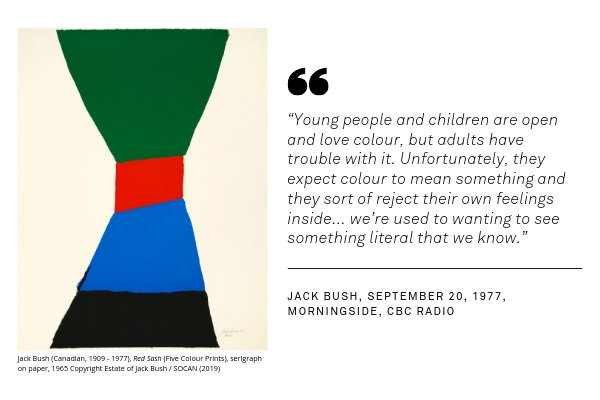
Known for his bold use of colour and iconic compositions, Jack Bush (1909-1977) was a pioneer of post-painterly abstraction and one of the first Canadian artists to gain international recognition. A prominent member of the Painter’s Eleven (1953-1960)–who came together through a common commitment to minimalism and abstraction–Bush helped to solidify the importance of abstraction within the Canadian canon and inspire generations of artists.
As an extension of his interest in form, for the past three years, Francisco-Fernando Granados’ has maintained a near-daily drawing practice informed by the compositional strategies of Jack Bush. Produced on a touch-screen phone, these series of abstract drawings are both an affectionate homage and a quiet subversion. Trained in the history and practice of drawing and painting, Granados was inspired by the National Gallery’s 2014-15 Jack Bush retrospective, an event that closely coincided with the death of his father. The ritual of drawing became folded into a process of mourning and grief that has extended into his everyday life. How does one pay homage? How do we contend with the legacies of those who have come before us?

Grandos’ series towards a minor abstraction and letters are both offerings and provocations. Here, with trained fingers moving across the smooth and familiar surface of a screen, Granados paints to dialogue in a medium that is built for quick exchange. Guiding the abstract compositional impetus away from Modernist concepts of autonomy, the works push towards an open-ended politics informed by his queer and refugee experiences. In duet, the discourse between past and the contemporary is understood as ongoing and reciprocal. The dialogue between Jack Bush and Francisco-Fernando Granados, though displaced by decades, reaches across history in an effort to touch that which seems untouchable, to reshape what seems set.
This exhibition is generously supported by the Ontario Arts Council Exhibition Assistance Grant.