Looking back in honour of Durham Region Pride!

In 1972, Paul Bennett (Director, 1969 – 1972) was “asked” by the Board of Directors to resign because of his sexuality.

This is a part of the Gallery’s history we are not proud of. What we are proud of is how far we’ve come: that we have exhibitions that boldly address queer issues; that we can work closely with our queer community in developing relevant and required programming; that we support queer creatives and make space for their vibrancy.

This week is Pride in Durham Region. This week (and everyday) it’s important to live as proudly as you can, and support others as they do. We invite everyone to celebrate with us at RMG Fridays: Pride with live music from I. M. Brown & The Transcendents and film screenings, openings for new exhibitions, and much more.

Leila Timmins joins the RMG as Curator and Manager, Exhibitions and Collections

The Robert McLaughlin is excited to announce that Leila Timmins will be joining the Gallery as Manager and Curator, Exhibitions and Collections. In this new role, she will be replacing Linda Jansma who is retiring after 28 years at the gallery.

Previously Curator of Exhibitions and Public Programming at Gallery 44 in Toronto, Leila is dedicated to working with community to contribute to important conversations happening around and through art.

At Gallery 44, Timmins produced over 60 exhibitions and public programs with over 100 artists from across the country and abroad while working tirelessly to build the gallery’s audience and increase online engagement.

Accessibility is also an important part of Leila’s curatorial practice. Her work with Workman Arts, CAMH, Tangled Art + Disability, and numerous other groups and collectives has contributed to conversations around reducing barriers and increasing access.

“I am thrilled and honoured to be joining the team at the Robert McLaughlin Gallery. I’ve long admired the way the RMG centres relationship-building at the core of its operation, working closely alongside artists and community. I look forward to continuing the important work the gallery has done to build greater accessibility, equality and inclusiveness into all aspects of its programming.” says Timmins

“We’re very excited to have Leila at the RMG and working in Durham Region. She was selected from a pool of candidates nationally and abroad because her passion for community building is determined, which is demonstrated in her impressive list of experiences and accomplishments. Get ready, Durham.” says Donna Raetsen-Kemp, CEO, of the new arrival.

Her writing has been published in notable publications including FUSE Magazine and C Magazine, and was awarded the Emerging Cultural Leader Award by Artist-Run Centres and Collectives of Ontario (ARCCO) in 2017.

Leila starts at the RMG on June 11.

An event everyone is welcome at – RMG Fridays: Pride

Recently, The Robert McLaughlin Gallery made the decision to step away from Pride Durham in organizing RMG Fridays: Pride.

The RMG is committed to building and maintaining safe and accessible space so that the arts can be shared and enjoyed with the entire community. We also works closely with members of our communities, representative organizations, and groups when developing programming and exhibitions to ensure we are meeting the needs of our community.

At a recent meeting held by Pride Durham, members of our queer and racialized communities came forward to express their concerns and explain their requirements for safe space, including their stance on uniformed police walking in the parade. Pride Durham made a decision to move forward with plans that oppose those needs. Doing so holds the potential to compromise safe space and excludes those voices from the upcoming celebration. This does not align with the RMG’s values.

The Robert McLaughlin Gallery believes Pride is a celebration of resistance and resilience, differences and the vibrancy that come with being queer. Though intimately linked at times, Pride is about finding yourself not your profession. We invite the entire community to come together, whether in celebration or support, as the people they were born as.

We also understand that the uniform may be viewed as a symbol of years of oppression and the enforcement of laws that oppress many queer and racialized peoples. While the police are invited to participate in plain clothes, the presence of uniforms may be a barrier to access for many.

We hope to work with Pride Durham in the future, in ways that are safe, respectful, and healing for the community.

To learn more about the upcoming RMG Fridays: Pride event click here.

Q&A with Sonya Jones, Curator of Collections

Sonya Jones, previously Associate Curator, is now taking on a new role at the Gallery as Curator of Collections. In this new role, Sonya will lead the management, care and exhibition of the RMG’s collections, including the Permanent Collection, Thomas Bouckley Collection, and library and archives.

What is it that you love about working with the collections?

I love sharing the collection with the community, whether that’s through exhibitions, tours or our online database. I also love collecting and sharing stories about each work – it gives you a whole different perspective and appreciation. While curating is definitely the highlight of my job, I absolutely love collections management. I’m lucky I get to do both. Also, it never gets old walking into the vault!

In your opinion, what makes our collections special?

While we have a huge variety of artwork, historical, contemporary, mediums, styles etc, the part of the collection that sets it apart from other permanent collections is the large number of Painters Eleven we have, over 1,000 works. We have visitors come specifically to see Painters Eleven, for example just this week we had someone come all the way from Halifax just to see works by Painters Eleven.

In your new role, what do you look to do with the collection exhibitions?

I’m looking forward to connecting with our community through the collection and finding new ways for public engagement.

Do you have a favorite piece in the Permanent Collection? In The Thomas Bouckley Collection? Why?

Joseph Sydney Hallam (Canadian, 1899 - 1953); Rainy Weekend; 1946; oil on masonite; Gift of Paul Hallam, 2002

Joseph Sydney Hallam (Canadian, 1899 – 1953); Rainy Weekend; 1946; oil on masonite; Gift of Paul Hallam, 2002

It’s so hard to choose just one! There are too many amazing works to choose from. I tend to have weekly favourites. One that I recently came across that left an impression was Joseph Sydney Hallam’s Rainy Weekend. This resonated with me because I saw it right after the most recent ice storm, which was a weekend where my family was stuck indoors. Despite grumbling at first, we soon took full advantage of spending quality time together. Like in Rainy Weekend, there’s a comfort and feeling of home just being together even if you are just in the same room doing your own thing. The weather forced us all to slow down, be present and be together. So that was that week’s favourite!

For the Bouckley Collection, I’ve always been drawn to the candid images, the ones that capture a moment rather than posed. For example, one of people walking down King Street during road construction. The majority of the photographs in the collection were taken for documentation purposes, so the candid photographs are extra rare and special.
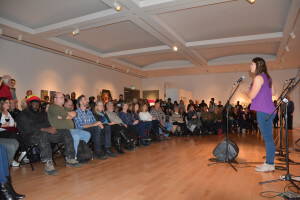

Light of the (Sugar) Moon

By Stephanie Pollard

March’s RMG Fridays buzzed with the ‘I can’t wait for Spring!’ energy that follows long
weeks of cold and 4:30 p.m. sunsets, the kind that anticipates what new beginnings await.
Guests came in to enjoy performances by musicians Melanie Herbert and Morgan Steele, as
well as a new exhibition that celebrated the new perspectives that come from remixes.

Curated by Pete Smith, Can I Kick It? looks at what would happen if visual art got remixed in the
same way music often does, and how artists allow other artists to re-interpret original material.
Artists were invited to create a piece, who then chose a colleague to remix their work. The
result? A culmination of paintings that combined showcasing signature styles, without interfering
with the work’s initial meaning.

Upstairs, guests learned that the Sugar Moon marks the Anishinaabe new year, and the time
when the sap from maple trees begins to run. Like many new years, the Sugar Moon also
celebrates new opportunities.

The Bawaajigewin Aboriginal Community Circle board member Peggy Forbes hopes this year
will give Indigenous residents in Durham Region a place to connect to their heritage, while
introducing it to the wider public.

“We’re really hoping that (Bawaajigewin Aboriginal Community Circle) will become a friendship
centre, which is kind of like a community centre that runs daily programs right from pre-natal to
senior levels for Durham’s Indigenous community,” Forbes said. As for new beginnings, Forbes
envisioned an ally-ship that understands we’re all in this together.

“Bawaajigewin is an Anishinaabe word that loosely means Seeing our dreams come to life.
What I’m hoping for is that everyone – Indigenous and non-Indigenous- can come together to
understand some of the issues that have been going on with our shared history – it’s not just
mine, it’s ours,” she said.

The Central Lake Ontario Conservation also made an appearance, offering guests a chance to
plan a trip to the Sugar Bush lantern festival (April 6, 7 – 9 p.m.), while the owners of the Food +
Art Cafe (also lovingly known as FART) had a table with homemade scones, and a location that
offers sip ’n’ paint (or sculpt!) nights. Owners Alison and Noel Galvan plan to share the fruits of a
combined dream, and Durham seemed like the natural place to start.

“When we decided we were ready to open the cafe, we found this perfect location right at
downtown Whitby, and we were like ‘Let’s go for it!’. We call it our happy place and we want
everyone to come in and be filled with yummy happiness, then conquer the day,” Alison said.

Join us again on April 6 for RMG Fridays, Spirit of Song, at 7 p.m.

Reagan Kennedy responds to Edward Curtis

This is an excerpt from Reagan’s full response, which can be seen off of the lobby at the gallery.

[…]

It is important to consider that at the time of Curtis’ career Indigenous populations throughout the continent had already suffered the severe effects of colonialism. It is because of this that many believe there is some validity to Curtis’ claim to be photographing a peoples who were “vanishing”. However, this language has also served to promote ideas that Indigenous people do not exist, and often prevents non-Indigenous peoples from really seeing us. Curtis was also known for his techniques of editing his images, often removing signs of modern technologies from his Indigenous subjects to promote ideas of primitivism. Additionally, he was known for stealing sacred items from communities which he would then travel with and place on his subjects in other territories.

Outside of these controversial and problematic components of his work, many of us are still drawn to these images. I am drawn to Picking Blueberries because of these complexities, and because the image appears more candid than some of Curtis’ more obviously staged works. I feel a sense of calmness and humanity when I look at this photograph. Due to the effects of colonisation and colonial policies, many of us feel disconnected and deterritorialized from our communities and traditional ways of knowing. These ways of knowing, such as the berry harvest taking place in this image, reflect ways of knowing that strengthened and maintained our relationship to the land, to our families and communities. Some of us learned and still carry these ways of knowing, some of us are mourning the loss of these practices and are trying to learn.

By reflecting upon Picking Blueberries from the RMG Permanent Collection I hope visitors take the opportunity to revisit how we have been seen and unseen, but also how we have been disconnected and how we can reconnect.

-Reagan Kennedy

RMG Fridays: Speak Your truth

By Stephanie Pollard

“There are only two mistakes one can make along the road to truth: not going all the way, and
not starting.” – The Buddha

February’s RMG Fridays touted #BlackExcellence as artists shared their perspectives on what it
means to belong.

Partnering with the Durham Black Educators Network (DBEN), the gallery became a capsule of
memories that showed how families came from various islands in the Caribbean to Oshawa,
and how their experiences have a solid place in Durham Region.

“It’s really about intercultural dialogue. We want people who don’t typically have exposure to
have an awareness of the value that Black culture brings to the community, so that everybody
can understand and be a part of celebrating (this) history”, explained DBEN Chair Eleanor
McIntosh.

According to the Library and Archives of the Government of Canada website, Black people have
been in Canada from as early as 1608, but the Immigration Act (1910 – 1967) prevented
persons deemed ‘undesirable’ from immigrating to the country, leaving a drop in migrants from
parts of Africa or the Caribbean until 1955, when the West Indian Domestic Scheme allowed
single women living in the Caribbean to work in Canada as domestic help for one year in order
to achieve immigrant status. While there is no information about the first Black families who
arrived in Oshawa, there was plenty of opportunity to get into a bit of personal history.

The Gallery A housed momentos that ranged from placemats to wood sculptures, lace
handkerchiefs, and a wedding dress – complete with a veil and gloves – that all told stories of
those who sought better living for their families, and the cultures they brought with them.

Meanwhile, upstairs guests sat down to enjoy the company of Michael St. George and Friends
ensemble, where music and dub poetry explored speaking one’s truth.

“It’s wonderful to be here…I feel like a complete circle,” Michael said as he led right into various
songs, poems and rhythms, with everyone in (timid) participation. The Durham School of Ballet
and Contemporary Dance (DSBCD) also featured performances that showcased pride in Black
culture with a duet to Solange’s Don’t Touch My Hair , and a solo piece called Bloodline .

Embracing diversity means opening our arms to a past that doesn’t let us get away with an easy
narrative, nor does it allow us to live in shame. If we can speak our truths, and acknowledge the
truths of others, we inch ourselves closer to equality.

Join us for another RMG Fridays on March 2, Sugar Moon, at 7 p.m.!

National Philanthropy Day: AWCCU Financial

Philanthropy is you and me, doing what we can, where we are and with what we have. National Philanthropy Day® celebrates the charitable work that EVERYONE does to make a difference in their communities —what you do from the heart makes a difference!

National Philanthropy Day is recognized on Nov. 15, but we celebrate what you do throughout the year. You make a difference every day!

Meg Cox from AWCCU chats with the crowd about the imprtance of community building events.

Meg Cox from AWCCU chats with the crowd about the imprtance of community building events.

The Robert McLaughlin Gallery is a place where emerging talents explore and develop their skills, where children build confidence, explore their imagination and where families can create together. We’re able to do this better than ever before with the support of AWCCU Financial.

AWCCU Financial generously provides funding for RMG Fridays. Enjoyed by over 3,100 people last year, their support has had immeasurable impact not only to those members who have been given the opportunity to share, explore and engage in the arts, but also to the local businesses and organizations who display their purpose.

“It’s about bringing people together and making things happen in Oshawa, Durham. It just gets bigger from there”. Meghyn Cox, AWCCU Financial

We are proud to say we are a partner with AWCCU Financial.


NPD logo

National Philanthropy Day: Ontario Power Generation

Philanthropy is the love of humankind, and National Philanthropy Day® celebrates the charitable work that EVERYONE does to make a difference in their communities. Whether you donate or volunteer (or both!), young or old, no matter how much you give or what causes you support—what you do from the heart makes a difference!

National Philanthropy Day is recognized on Nov. 15, but we celebrate what you do throughout the year. You make a difference every day!

The Robert McLaughlin Gallery would like to acknowledge the annual support received from the Ontario Power Generation (OPG).

The OPG Corporate Citizenship Program has supported the RMG in our pursuit to provide informal learning of abstract art, encourage collaboration, increase understanding of art fundamentals, and enhance the learning and quality experience between adult and child. OPG Second Sunday’s have been enjoyed by over 5,000 families because of this partnership.

When we bring together the passion and commitment of our partners, we push the boundaries of what is possible. We are proud to say we are a partner with OPG.


NPD logo

Finding Hygge in Community

By Stephanie Pollard

November’s First Fridays at RMG was a night of Hygge (HUE-gah), where artists and art lovers spent the evening celebrating good wine, good music and good company surrounded by (flameless) candles, blankets, and rock lamps.

Treasured in Danish culture, Hygge describes taking time to enjoy life’s simple pleasures like contentment and spending time with loved ones. In RMG’s case hygge was sitting in companionable silence cuddling partners, parents or children (once they sat still), and listening to two people and a guitar sing about what makes them feel love and contentment.

Musicians Brooklyn Doran and Rory Taillon stopped by the gallery as part of their Canada-wide tours, playing singles off their albums (Paper Wings and Only Whispers respectively), and taking turns to sing duets for individual performances. Brooklyn let the audience know how much the atmosphere meant to her, compared to what she expects when playing a concert.

“It’s really nice to play somewhere that I can wear comfy sweaters and talk about how I came to write the songs I’m performing for you guys- usually when I’m playing concerts in bars I have to scream for anyone to hear me,” she quipped.

Meanwhile, things were a bit louder downstairs.

Occuply Oshawa was organized chaos as the series showcased art and community activism through stickers. Also known as slap tagging, sticker bombing, or sticker slapping, guests opened themselves to a barrage of colour, drawn-over political portraits, comic bubbles and cuss-word laden opinions. Like the space it was curated in, Occuply Oshawa looks at the democratic powers of urban art, and how it’s used to force difficult conversations among readers.

Another conversation guests could have was with RMG’s current artist in residence, visual artist Carolyn Code. Originally from Peterborough, the jewelry maker turned sculptor applied to the gallery’s program to explore the process of creating sculptures with paper.

“It’s always something I wanted to try, so when I started my residency I brought different types of paper and objects and just started playing around with them,” she explained. So far, her favourite piece is a delicate structure of paper bowls strung together and placed according to size on the wall.

“I’m not sure if I want to add to add more pieces, but I’m glad that opportunities like this (the residency) exist in Oshawa where I can spend time with the process and still be close to home,” Code said.

Join us on Friday, December 1 for our next First Fridays at RMG Heavy Hitters at 7 p.m.