Oshawa Assembly

Created using source material from the Thomas Bouckley Collection, Whitby-based artist Wes Peel’s cyanotype photomontages bring together various historical photographs of Oshawa to create new narratives and offer different perspectives. In describing the series, Peel says the works, “combine and unify different objects and moments together. As with other forms of collage and photomontage, new combinations [of images] create new ways of seeing, and our mind invariably looks for connections.” Here, the combination of different images create fantastical scenes where fact and fiction merge. For example, in Ghost Tuners apparitions of Williams Piano Company employees playing instruments appear floating in front of an interior view of the factory.

The Thomas Bouckley Collection, holds over 3,500 historic and contemporary photographs of Oshawa and the Durham region, providing a vital resource for connecting the community with local history. Thomas Bouckley’s goal in putting his collection together was to create a photographic archive documenting the evolution of Oshawa. Peel transforms the images in the collection to encourage stories that contribute to a shared history.

A hybrid of digital and traditional methods, Peel’s cyanotypes are created by collaging digital images which are printed as negatives. The negative is then placed on chemically-coated paper and exposed to light, creating the blue-hued image. Cyanotypes are an early photographic process dating back to the 1840s and their nostalgic quality is fitting for Peel’s historical reinterpretations. Alternative photographic processes continue to draw artists for their simplicity, expressive qualities and unique aesthetic. Born and raised in Oshawa, artist Wes Peel currently lives in Whitby and is an arts educator at Henry Street High School.

IMPACT

“Every work of art which really moves us is in some degree a revelation – it changes us.”
– Lawren Harris

What IMPACT can art have?


The word IMPACT is defined as a physical force, an influence, or a strong effect. Art has a unique ability to effect or influence our daily lives, challenging us and changing our perceptions, through a sensory experience. For the individual, art can affect you visually and emotionally, while collectively, it can have important broad social reach. Exploring the many ways art can impact us, this exhibition draws together works that consider human impact on the land, the effects of war, politically and socially engaged art, emotional storytelling, and visually compelling abstraction.

The RMG’s vision is to flourish through arts, culture, and community connection and resilience. With a mission to work together with our communities to create conversations through the arts, we encourage people to experience the world differently. We believe that art and culture can improve quality of life, act as a vehicle for public discussion, understanding, and connection, creating impact within our community and beyond.
The belief that art can better our community also shapes how we build our collection: the RMG is dedicated to collecting with intention in order to reflect diverse voices and contemporary issues, while continuing to tell the story of Canadian art. Drawn from our Permanent Collection of over 4700 artworks, the work in IMPACT reflects the depth and breadth of our growing holdings, and encourages conversations about the effects of art.

Oddity and Wit

Artworks can make you look twice, scratch your head, or maybe chuckle. There are a number of works in the RMG’s collection of over 4,700 artworks that do just that; whether intentionally funny, a play on words in the title, or just plain odd, this exhibition explores a selection of humorous works.
Humour and art have a lot in common. Both can question or poke fun at the status quo, and both have strong persuasive power and the ability to engage with socio-political commentaries in an accessible way. Historically, humour has long existed in art in a nuanced form, but the art movements that placed humour at the forefront were Dadaism and Surrealism. Dada artists such as Marcel Duchamp used humour and absurdity to comment on the institution of art and the role of the artist in society. Similarly, in this exhibition, Donna Ibing’s Be an Artist Board Game makes light of the many challenges facing professional artists today. Surrealism took an approach to humour with a more bizarre and irrational tone, focusing on the subconscious, absurd and strange. An example of this type of approach is found in the print Down to the Corner Store for a Loaf of Bread by Kerry Joe Kelly, a self-described surrealist, who depicts a man smiling with an armful of feet.

Art does not always have to be serious–it can change your perspective in a light or amusing way. At their core both art and humour offer an escape from the weight of life, and this exhibition shows the many ways that art can use humour to engage viewers and provide respite from the everyday.

In Our Minds


This exhibition was produced in partnership with Ontario Shores Centre for Mental Health Sciences.

In February, we partnered with Jordon Beenen, Ian Hakes, and Lori Lane-Murphy, Ambassadors of Hope for Ontario Shores Centre of Mental Health Sciences, to develop a community-driven Painters Eleven exhibition. At the RMG we believe partnerships create important opportunities to positively reflect the creativity and diversity of our communities, and help deepen engagement with our Permanent Collection.

A central part of the RMG’s Permanent Collection is a significant number of works by Painters Eleven, a collective of abstract artists, who founded their group at Alexandra Luke’s cottage located on the boundary of Oshawa and Whitby, not far from Ontario Shores Centre for Mental Health Sciences. Abstract expressionist works are often created with a spirit of spontaneity and the bold use of colour and form can evoke different emotions. The immediacy and affective qualities of the work drew Jordon, Lori, and Ian to engage with Painters Eleven, allowing them to connect to the work through the lens of mental illness. They each chose works that resonated with them personally and creatively responded, expressing their stories, through writing, art, and performance.

Throughout this collaboration Jordon, Ian and Lori shared stories of their lived experience with mental illness, explored Painters Eleven, and participated in the exhibition development. The resulting exhibition, In Our Minds, includes personal reflections and highlights the power and importance of art to drive community conversation about mental illness. This partnership has been one of meaningful exchanges, relationship building, openness, and enlightenment—a journey that has left a lasting impression on participants and staff alike.


Then and Now

This exhibition was produced in partnership with the Oshawa Senior Citizen’s Camera Club

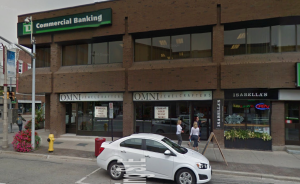
This exhibition marks the 5th installment of the Then and Now series, a collaboration with the Oshawa Senior Citizens’ Camera Club. This project focuses on the importance of local businesses and social services and how they contribute to a vibrant and flourishing community. Inspired by historical images from the Thomas Bouckley Collection that depict proud merchants posed by their businesses, members of the Camera Club have continued this tradition by photographing current business and service locations. These photographs will then be added to the Thomas Bouckley Collection in order to stay true to Bouckley’s vision of capturing the continued evolution of Oshawa.

The BIA describes downtown Oshawa as “a vibrant mix of business, culture, entertainment and academia; a place where people come to work, learn, live, enjoy art and music, watch live sporting events, meet for drinks and enjoy great food.” The various locations depicted in this exhibition captures the feeling and purpose of a downtown core, and highlights the people who make it possible.

Thank you to the businesses and services for their enthusiasm and participation in the project. Special thanks goes to the Oshawa Senior Citizens’ Camera Club for their dedication in telling the continuing story of Oshawa in their exploration of yesterday and today.

duet

Presented in partnership with the Art Gallery of Peterborough and the City of Peterborough.

Opening Reception – Friday, June 7, 7PM – 10PM 

duet brings together work by Jack Bush and Francisco-Fernando Granados to both invoke the aesthetic legacies of modernist abstraction and to initiate a dialogue on contemporary understandings of this period and its visual strategies. By pairing paintings and prints from the mid-twentieth century with site-specific and digital works from a contemporary moment, the exhibition creates a conversation on abstraction that transcends space, time, and medium.

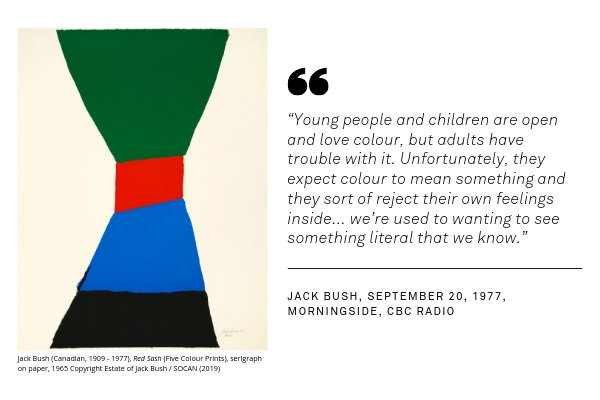
Known for his bold use of colour and iconic compositions, Jack Bush (1909-1977) was a pioneer of post-painterly abstraction and one of the first Canadian artists to gain international recognition. A prominent member of the Painter’s Eleven (1953-1960)who came together through a common commitment to minimalism and abstractionBush helped to solidify the importance of abstraction within the Canadian canon and inspire generations of artists.

As an extension of his interest in form, for the past three years, Francisco-Fernando Granados’ has maintained a near-daily drawing practice informed by the compositional strategies of Jack Bush. Produced on a touch-screen phone, these series of abstract drawings are both an affectionate homage and a quiet subversion. Trained in the history and practice of drawing and painting, Granados was inspired by the National Gallery’s 2014-15 Jack Bush retrospective, an event that closely coincided with the death of his father. The ritual of drawing became folded into a process of mourning and grief that has extended into his everyday life. How does one pay homage? How do we contend with the legacies of those who have come before us?

Grandos’ series towards a minor abstraction and letters are both offerings and provocations. Here, with trained fingers moving across the smooth and familiar surface of a screen, Granados paints to dialogue in a medium that is built for quick exchange. Guiding the abstract compositional impetus away from Modernist concepts of autonomy, the works push towards an open-ended politics informed by his queer and refugee experiences. In duet, the discourse between past and the contemporary is understood as ongoing and reciprocal. The dialogue between Jack Bush and Francisco-Fernando Granados, though displaced by decades, reaches across history in an effort to touch that which seems untouchable, to reshape what seems set.

This exhibition is generously supported by the Ontario Arts Council Exhibition Assistance Grant.

red and transparent AGP logo copy                  PTBO-logo-tagline-black           

The Trees Want to Remain Quiet, but the Wind Won’t Stop

Opening Reception – Friday, May 3, 7PM – 10PM

The Trees Want to Remain Quiet, but the Wind Won’t Stop brings together two bodies of work by Montreal-based artist Hua Jin. Exploring the relationship between landscape photography and solitude, the works portray different wooded areas as a means of reflecting on both the timeless nature of landscape photography and the constant cyclical nature of a forest. The eponymous work, The Trees Want to Remain Quiet, but the Wind Won’t Stop consists of eight monitors, each depicting a single tree reflected in water, continuously abstracted by the wind. According to Jin, the word landscape in Chinese is expressed as two characters, 风景, the first meaning wind and the second meaning both scene and light, which suggests not only a location but also how it is perceived. The second body of work Forest similarly plays with perception, depicting an old growth forest in Langley BC as a large panorama stretching over twenty-five feet. The meticulous detail captured in the image shows various stages of decomposition alongside growth and renewal with new buds and small shoots emerging from the verdant undergrowth. Jin’s elongation of time and space in both these works offers an eloquent way to see these landscapes anew.

Home Made Home: Patch Work

Opening Reception – Saturday, May 11, 2PM – 4PM 

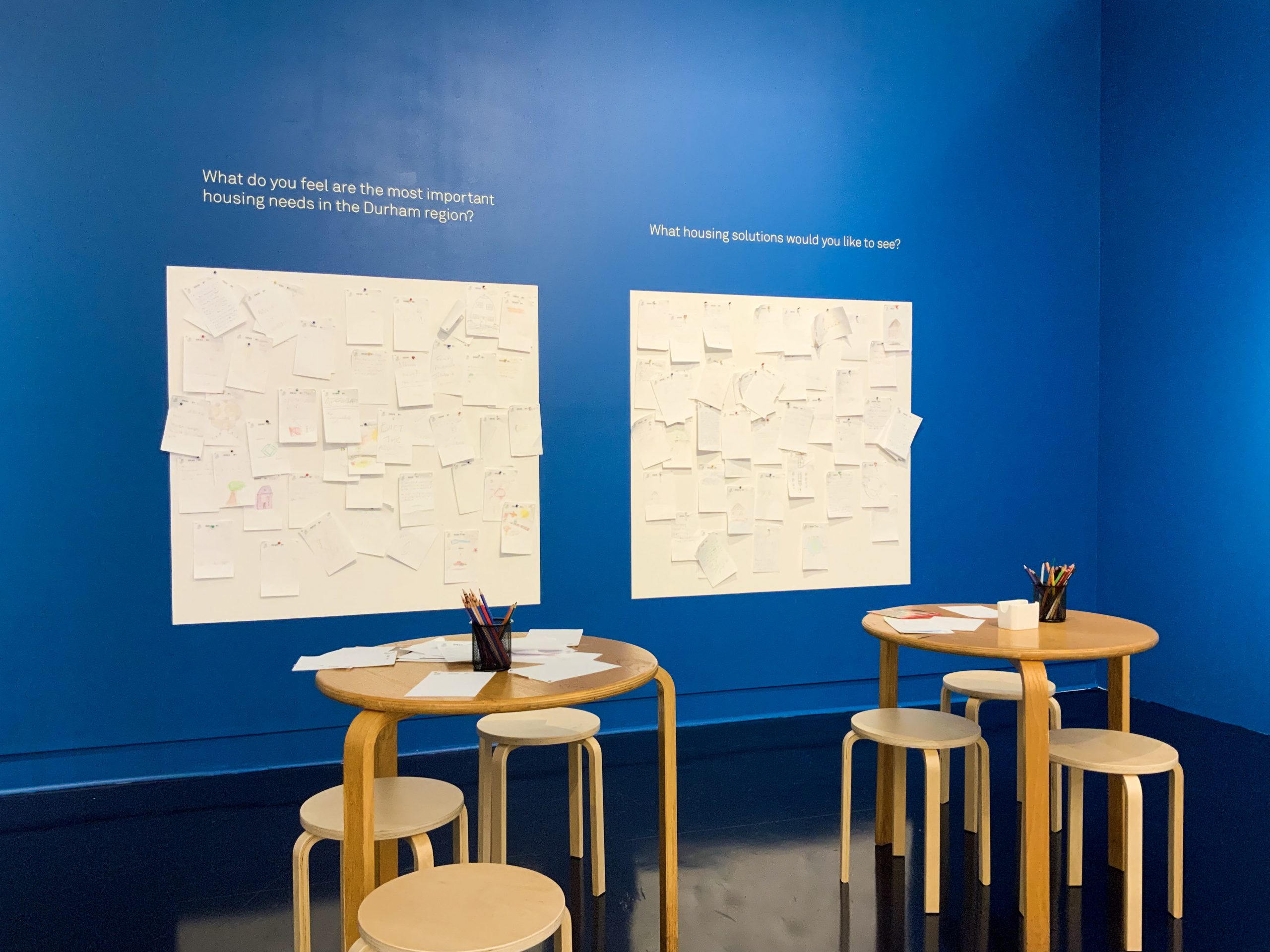
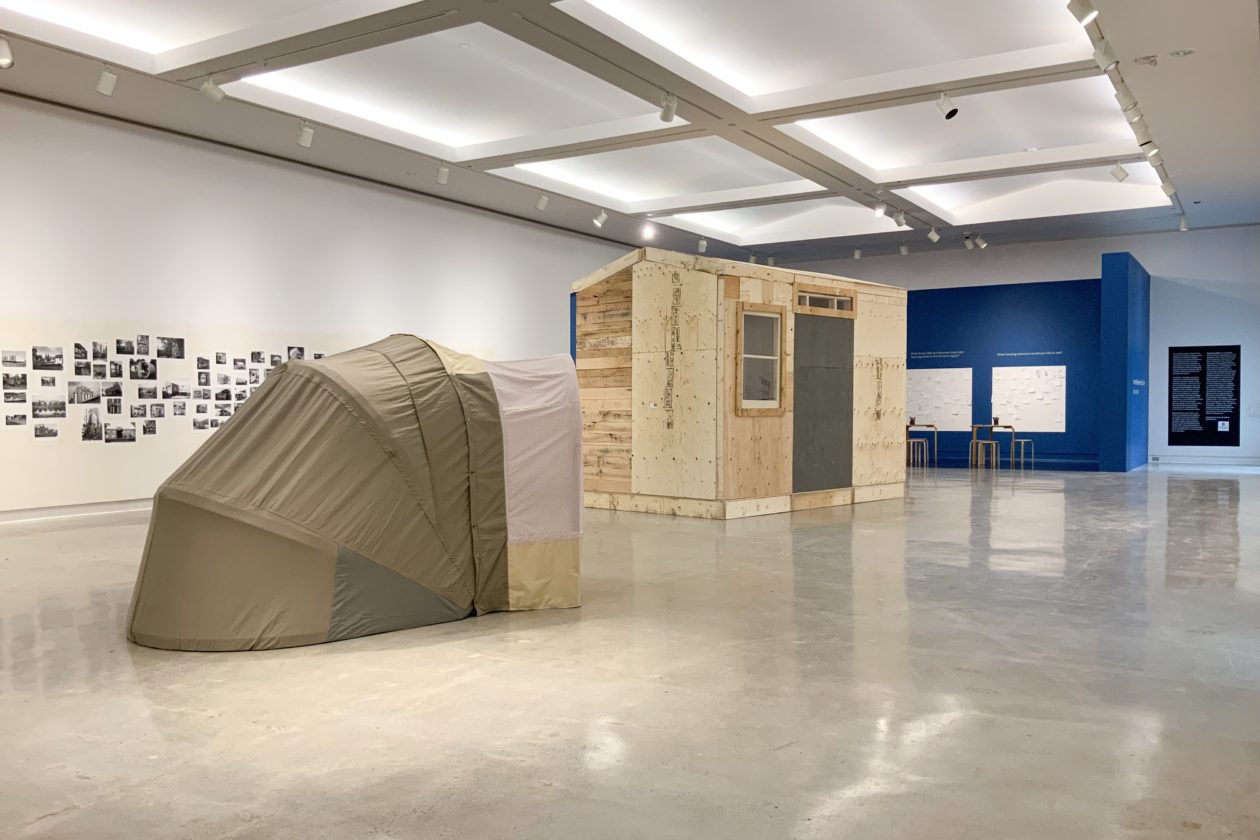
Home Made Home: Patch Work is a new project by Vancouver-based artist Germaine Koh, which explores complex housing issues relevant the Durham Region, and opens a conversation about civic responsibility, housing standards and the potential of alternative building models. For the exhibition, Koh has designed two provisional structures which provide practical solutions for emergency shelter. The first, a modular structure made from recycled materials, and the second, a small-scale building system in the form of a set of reusable panels that can be quickly assembled. Working together with members of the community, each of the panels will be created by various groups offsite and then brought together within the gallery. This framework, much like a patchwork quilt or old-fashioned barn-raising, draws on the skills within the community and provides a structure for individuals to contribute to communal needs. Starting from a DIY ethos, the works in the exhibition seeks to re-imagine housing conditions through models that address specific needs. Other projects by Koh in the Home Made Home series offer more speculative or utopian propositions that envision other possibilities for dwelling and sharing space.

Germaine Koh is a Canadian artist based in Vancouver, in the unceded ancestral territories of the Musqueam, Squamish and Tsleil-Waututh First Nations. Her work is concerned with the significance of everyday actions and common spaces, often adapting familiar objects to encourage connections between people and with the human and natural systems around us. Her current projects include Home Made Home, a project to build and advocate for alternative forms of housing, and League, a community project using play as a form of creative practice. Her exhibition history includes the BALTIC Centre, De Appel, Musée d’art contemporain de Montréal, Para/Site Art Space, Frankfurter Kunstverein, The Power Plant, The British Museum, the Contemporary Art Gallery in Vancouver, Plug In ICA, Art Gallery of Ontario, and the Liverpool, Sydney and Montreal biennials. In 2018-20 she is the City of Vancouver’s first Engineering Artist in Residence.

Download the Patch Work Manual for building the small-scale home as seen in the exhibition space here


Take a Look Inside

Riveting Women

2019 marks the 80th anniversary of the start of the Second World War. Women were recruited en masse to fill vacated positions left by men who were oversea fighting, particularly within the ammunitions industry. This exhibition explores the trailblazing working women of Durham Region who worked in factories, as nurses, and everything in between.

Shellie Zhang: The Ties that Bind

As Oshawa began to expand and industrialize in the early 20th century, in 1928, the first Business and Professional Buyer’s Guide was published by Alger Press Limited to highlight “manufacturing, business and professional interests” of the city and to generate continual growth.

In 1921, Oshawa had a population of approximately 13 000 people. Of that 13 000 people, 18 are listed in the census as being Chinese. There are no people of Asian descent, including Chinese, listed in any of the previous census record. This photo installation mimics a storefront window façade decorated three red endless knots that allude to the Boston Café, Ontario Laundry and the Globe Diner; three early Chinese establishments within a 5-minute walk of Core21. These three businesses were not included in the Business and Professional Buyer’s Guide.

In the foreword of the Buyer’s Guide, the publishers ask readers to bear with them as it is their first time undertaking a document of this nature and that errors of omission may be present. They cite the following lines from Puck’s epilogue in Shakespeare’s A Midsummer Night’s Dream:

“Gentles, do not reprehend,
If you pardon, we will mend.”
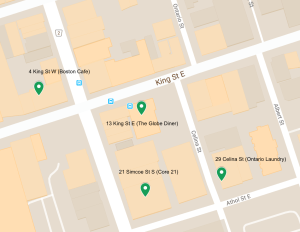
map1The impetus for the piece is to pay tribute and commemorate local histories have not been chronicled within the downtown core. What was the experience of owning a business in Oshawa for a Chinese family? What was it like to live as a Chinese-Canadian during Oshawa’s industrial boom? What (if any) forms of community were present for these Chinese-Canadians since they were so few in number? Chinese knots are an old form of decor with connotations of luck associated. One of the many symbolisms behind endless knots is that they link ancestors with omnipresence. This installation pays tribute to the legacies created from these first communities to make this largely unseen history visible.


Boston Café (4 King Street E), 1921

boston cafe

bostoncafetoday


Detail from photo of King Street, Oshawa (Ax995.194.1)

The Boston Cafe sign can be seen in the centre, just to the left of the man holding the ‘Go’ traffic sign.

The earliest records show that in the 1921 Canadian Federal Census for Oshawa and the 1921 City Directory

for Oshawa, there were two “nuclear” families living in Oshawa in the 20s and 30s, the Lem family and the Soo family. This Soo family comprised five of the eighteen Chinese people living in Oshawa during that year. They lived on Simcoe Street and Min Soo ran a restaurant called the Boston Café. Directory records show that Soo Min owned the Boston Cafe on 57 King St E until 1930 and then he reappears in 1938 as the proprietor of the Eden Inn on 8-10 Ontario Street. During this time, this part of King street was a ethnically diverse area, with people listed as being Ukrainian, Polish, Jewish, and Russian.

Ontario Laundry (29 Celina St), 1928
laundry2 laundry1


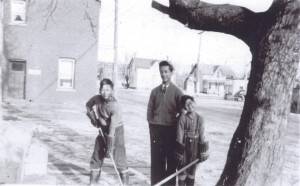
Hockey and Ontario Laundry, Thomas Bouckley Collection.

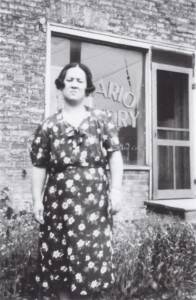
The photo on the left was taken at the back of Ontario Laundry, which was on Celina at Athol. Pictured here are 3 uncles of Brenda Joy Lem (photo source): George (the oldest), Uncle Edward (middle), and Uncle Norm (the youngest). Depicted on the right is a woman in a floral patterned dress, in front of Ontario Laundry, Celina St. at Athol. The woman is described by Brenda Joy Lem as her Grandmother, the photo possibly taken by Brenda’s Aunt. Brenda’s family owned the first hand laundry business in the City.
laundry3


The Globe Diner (13 King Street E), 1921
 s avanti


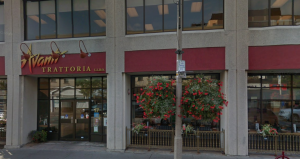
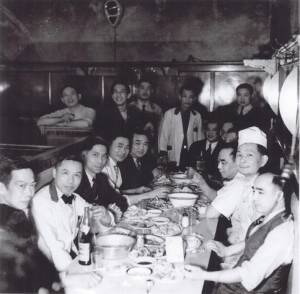
The Globe Diner, 2503, Thomas Bouckley Collection.

The Globe Diner was located on 13 King Street. In the 1921 Census it shows that this address was a single home rented by  a number of Chinese who were all listed as cooks or waiters, and that the Manager of the Globe Cafe, Lee Chow King (often abbreviated to L.C. King) was the head of household. In the 1928 directory, however, the Globe Cafe is listed as being owned by the Seto Bros. The Seto’s also operated the Waldorf Cafe at 11 Simcoe and later in 1937, the Seto Cafe at 11 Bond Street. In 1985 directory the Globe cafe became the The New Globe Restaurant and is shown as having moved to it’s current location on Athol Street. This photo with the staff members of the restaurant was taken around 1940. Back row, second from left is George Lem, uncle of Brenda Joy Lem. Man in bottom left is the grandfather of Brenda Joy Lem.

Special thanks for Brenda Joy Lem, and Jennifer Weymark and Alex Petrie from the Oshawa Museum for sharing their research and stories. To learn more about the history of early Chinese settlers in Oshawa, consult Brenda Joy Lem’s exhibition Homage to the Heart, and the Oshawa Museum’s ongoing research.


References

Lem, B. and Jansma, L. (2009). Brenda Joy Lem. Oshawa, ON: Robert McLaughlin Gallery.

Weymark, J. (2018). Asian History Month. [online] Oshawa Museum Blog. Available at: https://oshawamuseum.wordpress.com/2018/05/04/asian-history-month/ [Accessed 1 Oct. 2018].

Detail from photo of King Street, Oshawa (Ax995.194.1), Oshawa Museum

Ontario Laundry (2501), Thomas Bouckley Collection, Robert McLaughlin Gallery

Hockey (2502), Thomas Bouckley Collection, Robert McLaughlin Gallery
The Globe Diner (2503), Thomas Bouckley Collection, Robert McLaughlin Gallery