duet

Presented in partnership with the Art Gallery of Peterborough and the City of Peterborough.

Opening Reception – Friday, June 7, 7PM – 10PM 

duet brings together work by Jack Bush and Francisco-Fernando Granados to both invoke the aesthetic legacies of modernist abstraction and to initiate a dialogue on contemporary understandings of this period and its visual strategies. By pairing paintings and prints from the mid-twentieth century with site-specific and digital works from a contemporary moment, the exhibition creates a conversation on abstraction that transcends space, time, and medium.
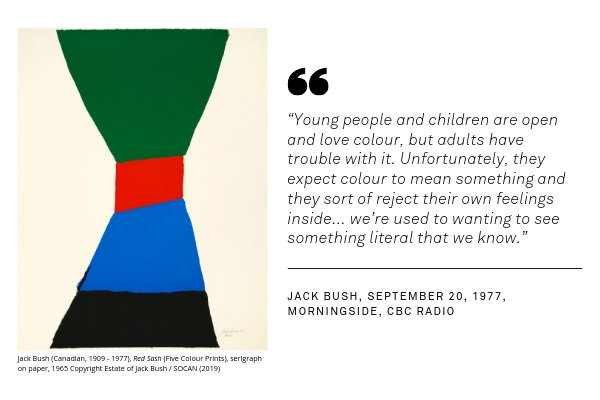
Known for his bold use of colour and iconic compositions, Jack Bush (1909-1977) was a pioneer of post-painterly abstraction and one of the first Canadian artists to gain international recognition. A prominent member of the Painter’s Eleven (1953-1960)who came together through a common commitment to minimalism and abstractionBush helped to solidify the importance of abstraction within the Canadian canon and inspire generations of artists.

As an extension of his interest in form, for the past three years, Francisco-Fernando Granados’ has maintained a near-daily drawing practice informed by the compositional strategies of Jack Bush. Produced on a touch-screen phone, these series of abstract drawings are both an affectionate homage and a quiet subversion. Trained in the history and practice of drawing and painting, Granados was inspired by the National Gallery’s 2014-15 Jack Bush retrospective, an event that closely coincided with the death of his father. The ritual of drawing became folded into a process of mourning and grief that has extended into his everyday life. How does one pay homage? How do we contend with the legacies of those who have come before us?

Grandos’ series towards a minor abstraction and letters are both offerings and provocations. Here, with trained fingers moving across the smooth and familiar surface of a screen, Granados paints to dialogue in a medium that is built for quick exchange. Guiding the abstract compositional impetus away from Modernist concepts of autonomy, the works push towards an open-ended politics informed by his queer and refugee experiences. In duet, the discourse between past and the contemporary is understood as ongoing and reciprocal. The dialogue between Jack Bush and Francisco-Fernando Granados, though displaced by decades, reaches across history in an effort to touch that which seems untouchable, to reshape what seems set.

This exhibition is generously supported by the Ontario Arts Council Exhibition Assistance Grant.
red and transparent AGP logo copy                  PTBO-logo-tagline-black           

The Trees Want to Remain Quiet, but the Wind Won’t Stop

Opening Reception – Friday, May 3, 7PM – 10PM

The Trees Want to Remain Quiet, but the Wind Won’t Stop brings together two bodies of work by Montreal-based artist Hua Jin. Exploring the relationship between landscape photography and solitude, the works portray different wooded areas as a means of reflecting on both the timeless nature of landscape photography and the constant cyclical nature of a forest. The eponymous work, The Trees Want to Remain Quiet, but the Wind Won’t Stop consists of eight monitors, each depicting a single tree reflected in water, continuously abstracted by the wind. According to Jin, the word landscape in Chinese is expressed as two characters, 风景, the first meaning wind and the second meaning both scene and light, which suggests not only a location but also how it is perceived. The second body of work Forest similarly plays with perception, depicting an old growth forest in Langley BC as a large panorama stretching over twenty-five feet. The meticulous detail captured in the image shows various stages of decomposition alongside growth and renewal with new buds and small shoots emerging from the verdant undergrowth. Jin’s elongation of time and space in both these works offers an eloquent way to see these landscapes anew.

Home Made Home: Patch Work

Opening Reception – Saturday, May 11, 2PM – 4PM 

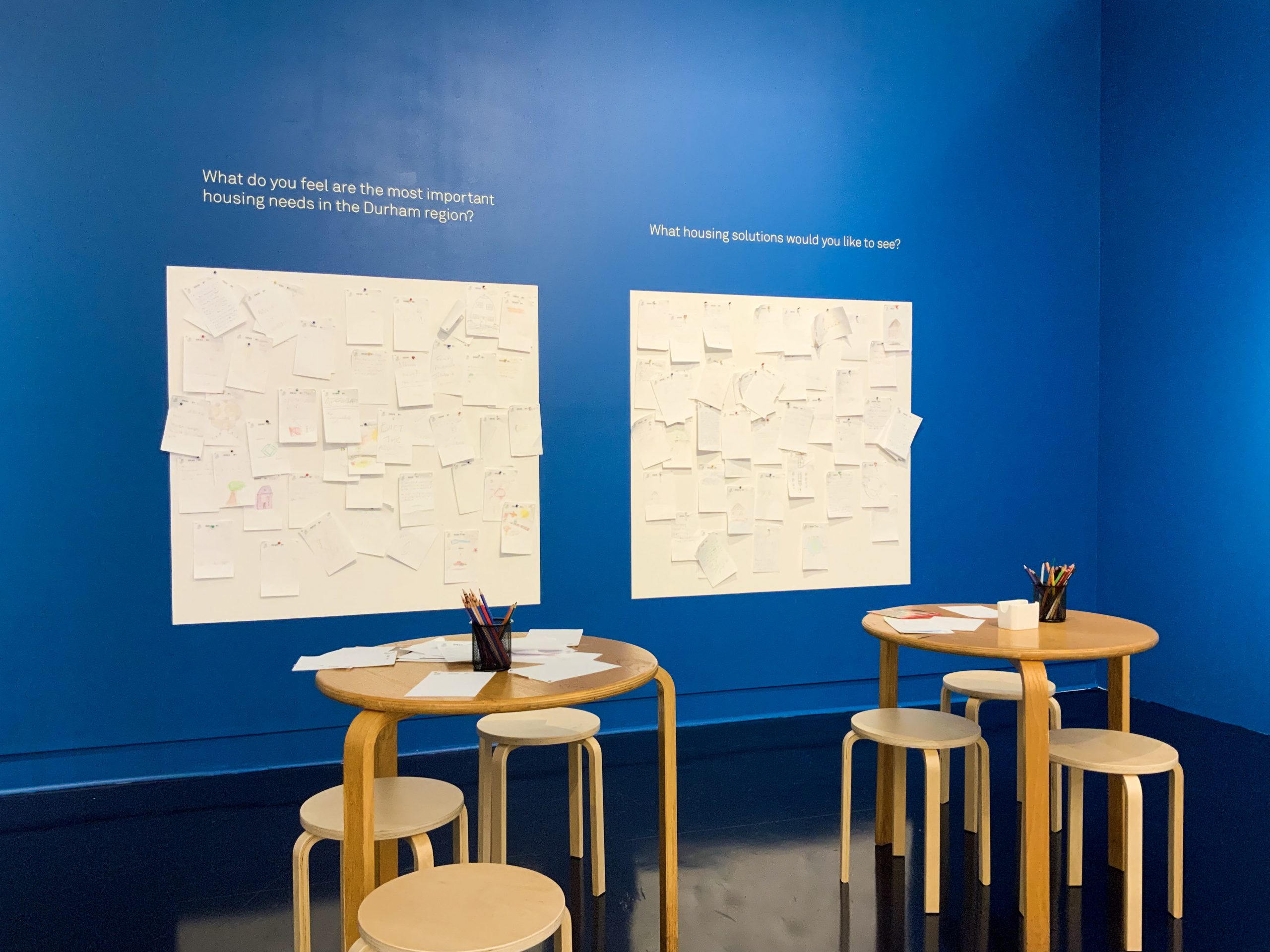
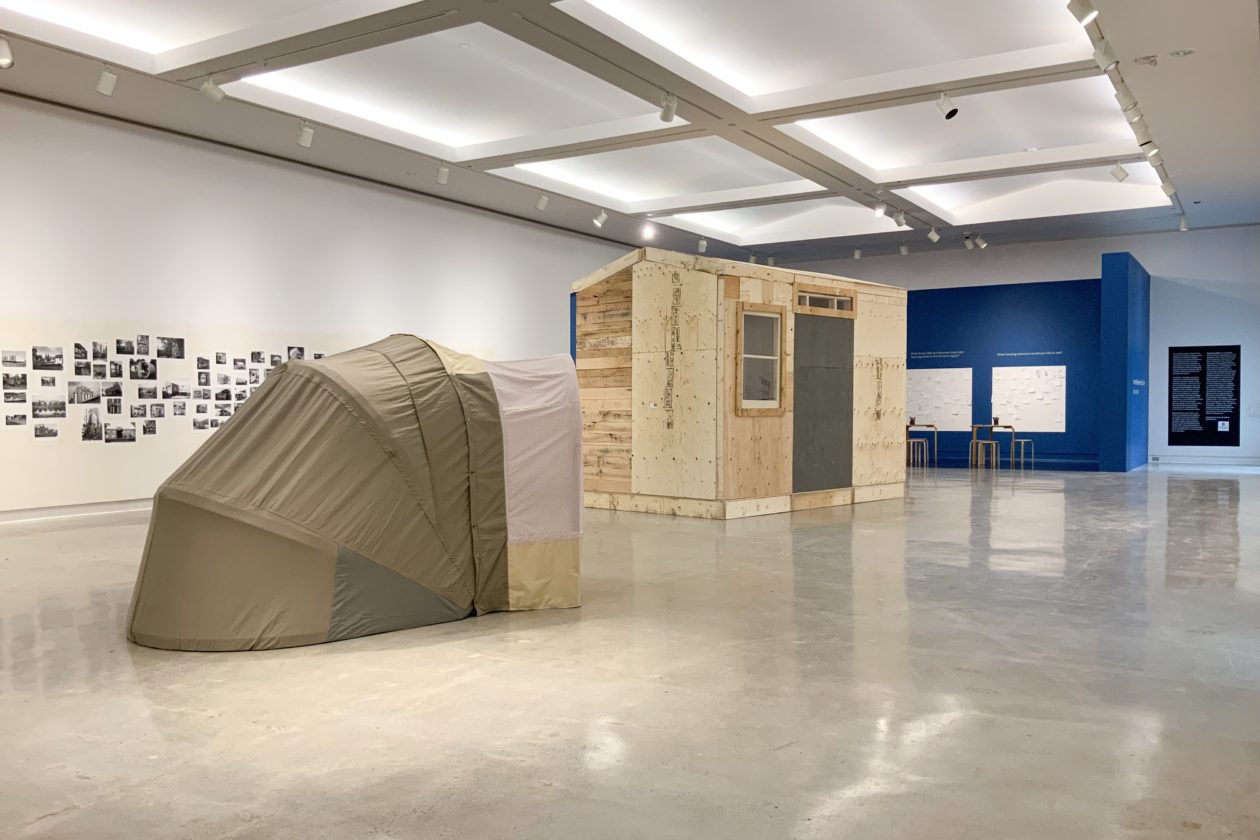
Home Made Home: Patch Work is a new project by Vancouver-based artist Germaine Koh, which explores complex housing issues relevant the Durham Region, and opens a conversation about civic responsibility, housing standards and the potential of alternative building models. For the exhibition, Koh has designed two provisional structures which provide practical solutions for emergency shelter. The first, a modular structure made from recycled materials, and the second, a small-scale building system in the form of a set of reusable panels that can be quickly assembled. Working together with members of the community, each of the panels will be created by various groups offsite and then brought together within the gallery. This framework, much like a patchwork quilt or old-fashioned barn-raising, draws on the skills within the community and provides a structure for individuals to contribute to communal needs. Starting from a DIY ethos, the works in the exhibition seeks to re-imagine housing conditions through models that address specific needs. Other projects by Koh in the Home Made Home series offer more speculative or utopian propositions that envision other possibilities for dwelling and sharing space.

Germaine Koh is a Canadian artist based in Vancouver, in the unceded ancestral territories of the Musqueam, Squamish and Tsleil-Waututh First Nations. Her work is concerned with the significance of everyday actions and common spaces, often adapting familiar objects to encourage connections between people and with the human and natural systems around us. Her current projects include Home Made Home, a project to build and advocate for alternative forms of housing, and League, a community project using play as a form of creative practice. Her exhibition history includes the BALTIC Centre, De Appel, Musée d’art contemporain de Montréal, Para/Site Art Space, Frankfurter Kunstverein, The Power Plant, The British Museum, the Contemporary Art Gallery in Vancouver, Plug In ICA, Art Gallery of Ontario, and the Liverpool, Sydney and Montreal biennials. In 2018-20 she is the City of Vancouver’s first Engineering Artist in Residence.

Download the Patch Work Manual for building the small-scale home as seen in the exhibition space here


Take a Look Inside

Riveting Women

2019 marks the 80th anniversary of the start of the Second World War. Women were recruited en masse to fill vacated positions left by men who were oversea fighting, particularly within the ammunitions industry. This exhibition explores the trailblazing working women of Durham Region who worked in factories, as nurses, and everything in between.

Shellie Zhang: The Ties that Bind

As Oshawa began to expand and industrialize in the early 20th century, in 1928, the first Business and Professional Buyer’s Guide was published by Alger Press Limited to highlight “manufacturing, business and professional interests” of the city and to generate continual growth.

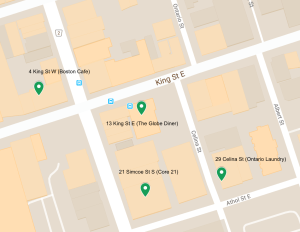
In 1921, Oshawa had a population of approximately 13 000 people. Of that 13 000 people, 18 are listed in the census as being Chinese. There are no people of Asian descent, including Chinese, listed in any of the previous census record. This photo installation mimics a storefront window façade decorated three red endless knots that allude to the Boston Café, Ontario Laundry and the Globe Diner; three early Chinese establishments within a 5-minute walk of Core21. These three businesses were not included in the Business and Professional Buyer’s Guide.

In the foreword of the Buyer’s Guide, the publishers ask readers to bear with them as it is their first time undertaking a document of this nature and that errors of omission may be present. They cite the following lines from Puck’s epilogue in Shakespeare’s A Midsummer Night’s Dream:

“Gentles, do not reprehend,
If you pardon, we will mend.”

map1The impetus for the piece is to pay tribute and commemorate local histories have not been chronicled within the downtown core. What was the experience of owning a business in Oshawa for a Chinese family? What was it like to live as a Chinese-Canadian during Oshawa’s industrial boom? What (if any) forms of community were present for these Chinese-Canadians since they were so few in number? Chinese knots are an old form of decor with connotations of luck associated. One of the many symbolisms behind endless knots is that they link ancestors with omnipresence. This installation pays tribute to the legacies created from these first communities to make this largely unseen history visible.


Boston Café (4 King Street E), 1921

boston cafe

bostoncafetoday


Detail from photo of King Street, Oshawa (Ax995.194.1)

The Boston Cafe sign can be seen in the centre, just to the left of the man holding the ‘Go’ traffic sign.

The earliest records show that in the 1921 Canadian Federal Census for Oshawa and the 1921 City Directory

for Oshawa, there were two “nuclear” families living in Oshawa in the 20s and 30s, the Lem family and the Soo family. This Soo family comprised five of the eighteen Chinese people living in Oshawa during that year. They lived on Simcoe Street and Min Soo ran a restaurant called the Boston Café. Directory records show that Soo Min owned the Boston Cafe on 57 King St E until 1930 and then he reappears in 1938 as the proprietor of the Eden Inn on 8-10 Ontario Street. During this time, this part of King street was a ethnically diverse area, with people listed as being Ukrainian, Polish, Jewish, and Russian.

Ontario Laundry (29 Celina St), 1928

laundry2 laundry1


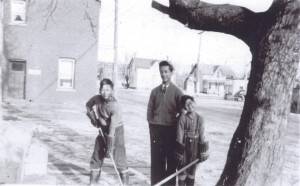
Hockey and Ontario Laundry, Thomas Bouckley Collection.

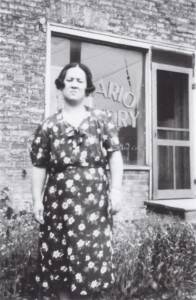
The photo on the left was taken at the back of Ontario Laundry, which was on Celina at Athol. Pictured here are 3 uncles of Brenda Joy Lem (photo source): George (the oldest), Uncle Edward (middle), and Uncle Norm (the youngest). Depicted on the right is a woman in a floral patterned dress, in front of Ontario Laundry, Celina St. at Athol. The woman is described by Brenda Joy Lem as her Grandmother, the photo possibly taken by Brenda’s Aunt. Brenda’s family owned the first hand laundry business in the City.

laundry3


The Globe Diner (13 King Street E), 1921

 s avanti


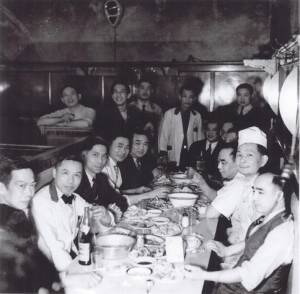
The Globe Diner, 2503, Thomas Bouckley Collection.

The Globe Diner was located on 13 King Street. In the 1921 Census it shows that this address was a single home rented by  a number of Chinese who were all listed as cooks or waiters, and that the Manager of the Globe Cafe, Lee Chow King (often abbreviated to L.C. King) was the head of household. In the 1928 directory, however, the Globe Cafe is listed as being owned by the Seto Bros. The Seto’s also operated the Waldorf Cafe at 11 Simcoe and later in 1937, the Seto Cafe at 11 Bond Street. In 1985 directory the Globe cafe became the The New Globe Restaurant and is shown as having moved to it’s current location on Athol Street. This photo with the staff members of the restaurant was taken around 1940. Back row, second from left is George Lem, uncle of Brenda Joy Lem. Man in bottom left is the grandfather of Brenda Joy Lem.

Special thanks for Brenda Joy Lem, and Jennifer Weymark and Alex Petrie from the Oshawa Museum for sharing their research and stories. To learn more about the history of early Chinese settlers in Oshawa, consult Brenda Joy Lem’s exhibition Homage to the Heart, and the Oshawa Museum’s ongoing research.


References

Lem, B. and Jansma, L. (2009). Brenda Joy Lem. Oshawa, ON: Robert McLaughlin Gallery.

Weymark, J. (2018). Asian History Month. [online] Oshawa Museum Blog. Available at: https://oshawamuseum.wordpress.com/2018/05/04/asian-history-month/ [Accessed 1 Oct. 2018].

Detail from photo of King Street, Oshawa (Ax995.194.1), Oshawa Museum

Ontario Laundry (2501), Thomas Bouckley Collection, Robert McLaughlin Gallery

Hockey (2502), Thomas Bouckley Collection, Robert McLaughlin Gallery

The Globe Diner (2503), Thomas Bouckley Collection, Robert McLaughlin Gallery


Feminist Land Art Retreat: Free Rein

Opening reception: January 19, 2-4pm

Free Rein is an installation by Feminist Land Art Retreat (FLAR), which reimagines hierarchical frameworks and proposes a vision of a possible future shaped by personal agency and autonomy. Centered around the three-channel video No Man’s Land, the work repurposes tropes of the Western film genre to subvert its typical narrative of a ruthless lone ranger out on the plain. Instead the video follows a number of horses through various landscapes and the women that take care of them, capturing their collaboration and shared pleasure in the labour at hand. The tenderness of their daily rituals reveal an interdependence, one where survival is not synonymous with conquest and expansion, but relies on mutuality and trust. Here, the concept of “Free Rein” is multiple, suggesting at once, the reins of a horse being freed from its rider, freedom from authority and land relationships that are beyond ownership.

Free Rein was first exhibited at the Audian Gallery (part of SFU Galleries) in Vancouver, May 31 – August 4, 2018, curated by Amy Kazymerchyk. The exhibition premiered No Man’s Land: The Trilogy, which was supported by SFU Galleries, the Western Front Media Arts Residency, Canada Council for the Arts, British Columbia Arts Council, and ACUD Gallery. The first chapter of No Man’s Land was presented at ACUD Gallery in Berlin, April 29 – May 28, 2017, curated by Elodie Evers.

Feminist Land Art Retreat (FLAR) was initiated in 2010 with an advertisement. In subsequent years, FLAR has produced promotional material for public circulation such as posters, t-shirts, postcards, temporary tattoos, and more recently performances and exhibitions. Using conceptual strategies and humour to subvert familiar visual forms and methods of information circulation, their work addresses social and cultural paradigms that construct notions of femininity and nature. Recent solo exhibitions include Free Rein, Audain Gallery, Vancouver; No Man’s Land, ACUD Gallery, Berlin; Heavy Flow: The Re-Release, Ginerva Gambino, Cologne; and Duty Free, Studio for Propositional Cinema, Düsseldorf.


The Machine Age

This exhibition explores industrial imagery in visual art from the RMG’s Permanent Collection. Since the early 20th Century, artists have embraced industry as a subject for various reasons, from a fascination and commentary on an evolving society and workforce, to simply being drawn to the formal qualities of industrial and mechanical structures.

Industrial images in art reflect the robust and ever-changing nature of a country in transition. The art in this exhibition shows the evolution of society from rural to urban, and from agricultural to industry.

Industrial architecture offers a unique formal and technical challenge to artists working with traditional media. Buildings, both interior and exterior, present a visual complexity of pipes, ducts, silos, and chimney-stacks. In works that depict exterior rural scenes, such as Yvonne McKague Housser’s Mine Elevator, these forms and structures look out of place in the natural landscape, their towering presence a reminder of the industry’s importance to the community in which it exists.

Once called the “Manchester of Canada” and “Canada’s Motor City”, Oshawa has historically been associated with industrial growth. The artists in this exhibition found inspiration in the changing mechanization of society as reflected in industrial growth and the changing world around them.

James Kirkpatrick: To The Unseen Future

Opening + Exhibition Tour

March 1st, 2019 as part of our RMG Fridays: To the Unseen Future event. James Kirkpatrick will be in attendance and will give an exhibition tour at 8:15pm. 

To The Unseen Future creates a space of spontaneity and discovery where social activity is unstructured yet unavoidable. Collapsing the boundary between artist, gallery and viewer, the exhibition will lead the visitor on a journey of discovery as one medium shifts and morphs into another. James Kirkpatrick’s work produces a space for social empathy to emerge, ignited by the intertwining of technological and human flaws, secrets and communication. He has gleaned his unique visual language through years of participation in the underground worlds of graffiti, hip-hop, noise music and surfing the Great Lakes.Kirkpatrick mixes vintage pop-culture imagery found in underground comics, retro video games, and outsider science fiction with symbolic references hidden in secret societies. He seamlessly integrates figuration and abstraction; painting and sculpture; drawing and sound; textiles and zines; performance and glitch. Weaving formal, alternate pop and historical elements into a very personal, visual narrative, Kirkpatrick delves into contemporary experiences while exploring archetypal questions.

Well known for his participation in the early Canadian graffiti movement and as avant-garde hip-hop artist Thesis Sahib, Kirkpatrick works in a variety of media including drawing, painting, sculpture, textiles, zines, mask-making and experimental sound improvisation. Most recently, he has incorporated kinetic and auditory elements into his work.

Curated by Lisa Daniels; organized and circulated by the Judith and Norman Alix Gallery in collaboration with The Robert McLaughlin Gallery

Unmasking Brain Injury

Opening: Thursday, November 22 from 6-9pm

The Brain Injury Association of Durham Region (BIAD) is dedicated to helping individuals and families impacted by brain injuries by connecting community members who share similar physical, emotional, intellectual, spiritual, and social needs.

Members of the association participated in an international movement coordinated by Hinds Feet Farm in Huntsville, North Carolina, to give a face to their injury.

From the months of February to June, members designed masks that reflect their lived experience with a brain injury, with the goal of increasing visibility and awareness around the impact of brain injuries.

The stories shared reveal the challenges that each individual experiences and unmasks what cannot be seen on the outside.

Luminous John Lander: Landscape, Portrait, and Still Life

Reception: Sunday, October 14, 1pm

Oshawa born artist John Lander (1951-1992) created a body of work in prints, paintings, and wood cuts, that speaks to an intense encounter with life. From his earliest screen prints to his final paintings, Lander’s aesthetic combines high style, humour, saturated colour, and a kind of yearning.

Luminous John Lander includes work exhibited during Lander’s solo exhibition at the RMG in 1988, as well as prints and paintings never previously exhibited, from several private collections.
Curated by Terry Sefton.

A printmaking workshop led artist Angela Hennessey has been developed based on this exhibition and Lander’s work. Click here to learn more!

Beginning September 14, 2026 the RMG will have new operating hours! Learn more about Wellness Wednesdays.
Mon-Tue CLOSED
Wed OPEN 10 AM – 8 PM
Thu-Sun OPEN 10 AM – 4 PM