In Review – RMG Fridays: Young Minds

By Stephanie Pollard

“I want all my children to have the things I couldn’t afford. Then I want to move in with them.”

-Phyllis Diller

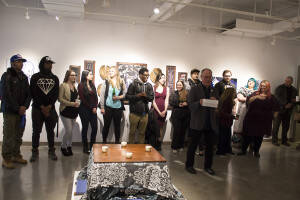
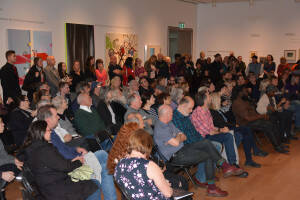
Wind and sputtering rain didn’t stop guests from enjoying May’s First Fridays at RMG, which celebrated Durham’s young people.

RMGFridays_May2017_photosLucyVilleneuve (69)

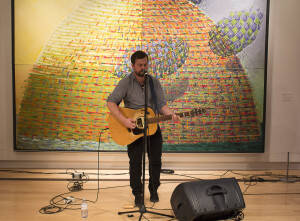
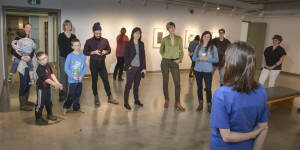
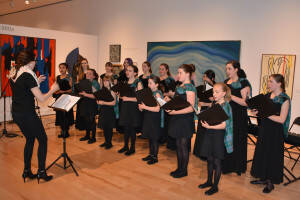
From performances by the Durham Girls’ Choir and spoken word artist Jaylen Stark with the O’Neill C.V.I. dance group, to the Durham Youth Council helping guests brush up on their Canadian history, young people got the spotlight to remind everyone that of all the requirements needed to make a contribution, age isn’t one of them. Kyle Fitzgerald, Chairman for the Durham Youth Council, appreciated the gallery for highlighting the young people who get involved in their communities throughout Durham, and noted that progress comes from everyone working together.

 
“I think we ( baby boomers, Gen. X-ers, and millennials) can view each other a lot better, and I think events like this that bring all generations together are really what’s going to benefit our region most, because we can learn a lot from the older generation, and the older generations can learn a lot from us- it goes both ways,” he said. As if to prove Fitzgerald’s point, guests could take a look at what the kids were up to via Friday’s Film Feature ‘Hero,’ presented by Vincent Massey Public School.


RMGFridays_May2017_photosLucyVilleneuve (66)Upstairs, performers and artists were in their elements as guests were introduced to four new exhibits: Saudade de Bahia (May 06, 2017 – June 11, 2017), ab Next (April 29, 2017 – September 03, 2017), Visitor Information (April 29, 2017 – September 19, 2017), and Abstraction: The Rebel Cause (April 22, 2017 – August 27, 2017), along with music by Emily Rocha, VINCE, and Jack of Hearts (Isabel). Food-wise, Gabriella Budani of Nourished on the Go, Oshawa’s very own vegan (!) restaurant, made an appearance to show her support and relieve Durham vegans of the where-can-I-go-for-lunch stress (16 Simcoe St. South).

 
“Well, there were no vegan options in all of Durham when we opened, so I knew there was lots of vegans around and I had a feeling they would be hungry, so I opened Nourished on the Go,” she said. Menu items include salads, soups, pasta dishes, and dessert – specifically a breakthrough full vegan vanilla cake.

 
Check out next month’s First Fridays on June 2 from 7- 10 p.m., where all things PRIDE take centre stage!

Carin Makuz: UpholSTORIES

By: Christy Chase

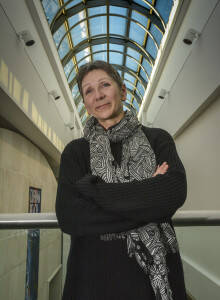
CarinMakuz_photo_AJ_Groen (2)

Carin Makuz Image couresy of AJ Groen

Carin Makuz is a Durham writer with an interest in the detritus we leave behind us. She started The Litter I See Project (litteriseeproject.com) which matches photos of litter she’s found with short written works by more than 100 Canadian authors, all in support of Frontier College’s literacy programs.

“I’m interested in how casually we drop things on the ground and discard things,” she said.

Her exhibit, which moves into the RMG Gallery A this spring, focuses on something you often see abandoned on the curb – couches.

She wonders who owned them, why they were abandoned and what stories these pieces of upholstered furniture could tell.

So she’s taken photographs of the many sofas she’s found and has asked friends and people she meets for their couch memories.

“I was stunned when everybody had one,” she said.

The exhibit, featuring 40 photos, is a memory project, a way to start conversations, she said. The couch memories she’s gathered will be posted, although no names will be used.

Since couches are great places for conversations, Makuz is hoping to start them with her exhibit.

“I’m going to create a seating area in the gallery to encourage people to stop, sit and have conversations,” she said.

They can also write down their own couch memories.

Makuz added the frames used for the photographs come from thrift shops and have, in a sense, been abandoned themselves.


—-

Christy Chase is a long-time resident of Oshawa, a writer, and former reporter and editor with local newspapers. She now enjoys exploring her artistic side at the RMG.

Recap – RMG Fridays: Adventure Handbook!

By: Stephanie Pollard

In ancient Rome, stones were marked with distances-usually a full, or part of a mile-and placed along the road, hence the word ‘milestones.’ Today, we know milestones as place markers that hold significance in a person’s or entity’s life, big or small. April’s RMG First Fridays celebrates two ongoing milestones: the 50th anniversary of the Robert McLaughlin Gallery, and the fourth thesis art exhibition from students in Durham College’s Fine Arts program.

Executive Dean of the college’s Fine Arts program Greg Murphy highlighted the students’ learning and personal journeys, noting that support always makes a difference.

RMGFridays_April (12) “It’s a partnership really. At the end of the day, you (the students) come out with this work with guidance from the faculty, and the faculty (comes) out with a pride in seeing you go through all the pain, joy, and learning that you go through from when you arrived here (Durham) to where you are now and the kind of work you’re producing, congratulations-really, really great work. I’m so happy to see that you stayed through,” he said to a group of budding artists who smiled shyly at a clapping audience. Professor Sean McQuay, Durham College President Don Lovisa and Mayor John Henry were also present.

Meanwhile, art enthusiasts, music lovers, and local get-together supporters made their way through various rooms upstairs, to either listen to musician Rob Moir, watch performances by the Maxwell Heights Dance Company or sample creations from upcoming businesses.

RMGFridays_April (2)

Norm Reynolds, co-owner of Brew Wizards Board Game Cafe, came to First Fridays to help RMG get a little closer to their next milestone, while encouraging samplers to visit their location (74 Celina St., Oshawa).

“We (work) with a lot of local businesses…we want to give back as much as we expect to receive,” he said. For three dollars, Brew Wizards visitors can access over 300 board games available, and re-fuel on homemade sandwiches, coffees, desserts, and draft beer.  As one of the few (only?) games cafés open to Monopoly masters in Oshawa, it made sense to open a business in Durham.

“We’re all from this part of the world. I grew up in Oshawa, two of the other guys grew up in Oshawa (and) one in Whitby, and we wanted something closer to home-so why not?” Norm said.

The next RMG First Fridays is happening on May 5 from 7 – 10 p.m. See you there!

Exploring the process: An interview with Anastasia Hare

By: Raechel Bonomo

Interview with Anastasia Hare
RMG Art Lab Residency: What Arises in the Process, December 6 – 30, 2016
Gallery A Exhibition: In Time, January 5 – 29, 2017
Participating artists: Katie Bruce, Jennifer Carvalho, Rob Nicholls and Sarah Sands Phillips
 

The relationship between the curator and the artist is one of complexities and involves an understanding of one another as deep in significance as the work itself. Art is vulnerable and often lends itself as an outlet of a deeper message hidden within the layers of its creator. When cultivating a collection of work, the artist must surrender themselves fully to a curator. Like many other relationships, the rapport between the artist and curator is a process; one Anastasia Hare is well-versed in.

Hare’s residency at the Robert McLaughlin Gallery (RMG) Art Lab looks to explore the progression of art to exhibition. The results of her residency took the form of an exhibit titled In Time, displayed in Gallery A from January 5 – 29, 2017.

I spoke with Hare about the intricacies of the relationship between curator and artist and how the process can be just as beautiful as the finished product.

 
Take me through the progression of curating a room.

My curatorial projects begin with encountering works of art at galleries, in magazines and online. If the work interests me I’ll usually pick up a card or save an image to refer to, or just remember the experience of the work and the themes resonating from it, and I’ll start to make connections between the artist’s works and the works of other artists. The premises further develop through research and dialogue with the artists, which frequently centre on their processes – an interest that stems from my own artistic experience. I might then explore topics related to the ideas behind the works.

I also consider the exhibition space, and look at the room overall as well as in detail with regard to each work and body of works, how the room is used and moved through, and envision views from various areas of the gallery. I arrange works illustrating their connections with adjacent works, and contextualize the grouping through my writing in didactics and essays.

Is there a difference in your methods when it comes to different mediums and style of work?

If it’s a medium that might not be widely familiar, I’d provide a brief explanation in the exhibition materials. When it comes to installing an unconventional medium or if there is a conceptual reasoning behind a particular display decision, I’d have more detailed conversations with the artist to ensure that the work is handled and displayed appropriately. I also consider series and distinct works in multiple arrangements – separately, in grids, pairings and groupings.


What was the most challenging exhibition to curate in your career thus far and why?

I think this residency exhibition may have had the most challenges because my focus on current works in progress meant a tight timeframe and the possibility that the work wouldn’t be complete for the exhibition. In some cases the artists may have been working on several projects at the time of our initial studio visits, and my selection of works needed to change based on what had been completed or the direction of the works.


Describe the relationship between the curator and the artist. Has there ever been a time when you and an artist had completely different interpretations on how their work should be displayed? How do you find common ground?

The relationship between the curator and the artist depends on the project and setting, but mostly I see my role as thoughtfully selecting, caring for and displaying artists’ works for public engagement. My approach is to get to know the artists’ practices as much as possible without preconceptions, I familiarize myself with their work before meeting but try to be open to different perspectives and actively listen to avoid misunderstandings.


Does the artist ever impact the way you curate their work? Did your methods in curating In Time change from artist to artist?

Absolutely, it’s important to me to discuss with the artists their individual wishes about how their work is displayed and care for each appropriately in my handling, as well as in my writing and presentation.

What was something you were surprised to discover while watching the process of these four artists unfold?

The artists were already quite comfortable with showing stages of their work, having participated in group critiques and actively using social media so I wasn’t surprised about their willingness to participate in a residency where I’d be showing bits of their processes, but I anticipated that perhaps the artists might be uncomfortable exhibiting work that was so recently completed or potentially still in its final stages. I wondered how this approach to an exhibition and the timeframe of the residency might encourage or restrict their work. Fortunately the artists responded positively when I invited them to participate, explaining that they were just starting a new body of work, had been thinking about trying to work with new media or techniques, had just moved or reorganized their studio.


How has this residency, seeing art being made in its most vulnerable stages onto its completion, changed the way you curate?

Aside from conversations with colleagues and perhaps posting an installation shot, I’d never shown the stages of development and artists’ processes creating the works leading up to an exhibition before. My ambition was to use the residency and exhibition as an opportunity to pursue an experimental project, while generating dialogue around creative processes and facilitating meaningful experiences with contemporary art. I decided to leave a booklet in the entrance of the gallery that includes a collection of anecdotes and excerpts of conversations with the artists, as well as photos of studio spaces, sketches, related earlier works and works in progress to reflect aspects of the processes involved, for visitors to peruse and make their own connections among the works featured in the exhibition.


———-

Raechel Bonomo is a writer and Oshawa-native. As a journalism-grad, Raechel looks to tell stories in various forms about various topics. Her lifelong love affair with art fuels her freelance writing but, by day, she works as the editorial coordinator for a conservation organization.

In her free time, she can be found either wielding a paintbrush or trekking through the unbeaten path in a forest somewhere in sourthen ontario.

The RMG’s 10-year-old curator

Sigourney Baker is a 10-year-old junior curator at the RMG.

The junior curator program explores the world of art galleries and exhibitions. The program gives kids the opportunity to learn how to develop themes while given a behind the scenes look of how an exhibition comes together.

While exploring works from the RMG’s permanent collection, Baker was impressed with the amount of animals she came across. Her love for animals, paired with a paintbrush, gave way for Bakers focus while curating Gallery.

For this exhibition, Sigourney had the pleasure of browsing through the gallery’s permanent collection – her favourite being Barry Smylie’s, Pineapple Cat. The water-based painting features a white-pawed black cat, peering over at the tropical fruit to its left.

JrCurators_Sigourney_photosAJGroen (15)Baker says she would trade being a 10-year-old to join her feline friends sunbathing any day happily.

When she’s not appreciating the magnificent art work of RMG, Sigourney enjoys to paint herself. Bakers says her favourite animal to paint or draw is a peacock, allowing her to blend a collage of colours.

While looking through the gallery’s collection, Baker noticed one of the animals depicted in one of the pieces, is now a member of the endangered species list.

When speaking on the importance of saving animals on the endangered spices list, Baker says, “I believe all animals should have a chance to live. I want to highlight what humans are doing to our planet and this is a good way to show it.”

———-

Jared Williams is a second year journalism student at Durham College. Jared is a reporter/photographer for the Chronicle. He is completing his placement at the RMG as the new Communications Intern.

Women in Art and Community

Women in Art and Community

There is no limit to what we, as women, can accomplish.
-Michelle Obama

Alexandra Luke would be proud. While we can only speculate on how she saw the future of a small building on Simcoe Street that housed works by the Painters’ 11 and other Canadian artists, fifty years later the Robert McLaughlin Gallery (RMG) has since been known as the space where art, thought, and community thrive.

March’s theme for RMG’s First Fridays paid special attention to the women who have, and still put their energies into pieces that inspire discussion and -hopefully, progress.

The night began with a combined piece by the women’s choir and senior dance ensemble from O’Neill Collegiate and Vocational Institute (OCVI). Choreographer Jenni MacNeil explained how the students working together symbolized their hope for rising above hatred.

“When many different art forms can come together under a common theme, that in and of itself is a beautiful model of diversity and tolerance, and how we see ourselves reflected in each other,” she said.
Later in the evening guests were invited to tour the gallery with in-house expert Steven Bland, and saw how some women in art celebrated womanhood in themselves, or ones they admired.

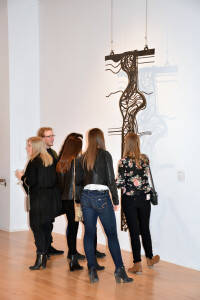
RMGFridays_March2017_LucyVilleneuve (151) Of course the discussion landed on Beyoncé. Specifically a metal work of Beyoncé’s silhouette fused to an energy source.

“(The artist’s) inspiration for this (piece) comes from hydro towers…her theme is to put power and the feminine together to show the power of women, she’s not making a joke of calling this (piece) ‘Beyoncé,’ because she is one of the most powerful women in the entertainment community… So really, it’s honouring Beyoncé,” Bland explained to admirers.

However, not far from the power piece, was another metal work of a woman’s body, as a bench.
Perspective, of sorts.

Meanwhile, musicians Trish Robb, entertainment specialist DJ Lynz kept guests in an upbeat and mellow vibe, while Caitlin and Cassidy McAuliffe, also known as the Woodland Sisters (@woodland.sisters), led an environment-conscientious workshop for more hands-on guests in the upper and lower levels respectively.

For more art and perspective, or a great night out that celebrates local creativity, head to the next First Fridays at RMG on April 7, at 7:00 p.m.

Jo Yetter: Dripping Faucets Are My Metronome

Jo Yetter: Dripping Faucets Are My Metronome
Art Lab through March 30

Jo Yetter is a Toronto-based artist who explores space, interpersonal relationships, identity and growth through printmaking, book art and installations.

“I like to say I work with space,” they said. “I make books but they are spaces to inhabit.”

Yetter is using their month in the RMG’s Art Lab to explore and to encourage discussion.

“I just want to use this space to experiment. I want to experiment with the narrative quality of objects, because they house people.

“I’m trying to make sense of people being transient in our lives.”

Yetter said they are concentrating on creating, not in making finished art works.

“It’s nice to not be so wrapped up in making something.”

They said when creating finished works, “I don’t let myself be as free as myself. “

They are also seeing themselves as part of the work.

“I really want to have the hand be a part of objects, as a way to insert my own visual poetry in this.”

These creations are installed on shelves in the Art Lab and Yetter hopes to start discussions about these. Gallery visitors are invited to bring in their own objects for discussion.

The works Yetter creates in the Art Lab will likely end up in future finished works, they said.

RMG 50

Memories, shared stories and laughter warmed a cold winter’s night at RMG Rewind, as the Robert McLaughlin Gallery continued to celebrate its 50th birthday.

On Thursday, Feb. 16, a group of gallery friends and present and former staff hit the Rewind button to remember the half-century of history of the RMG.
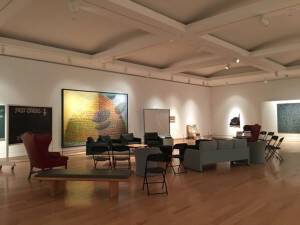
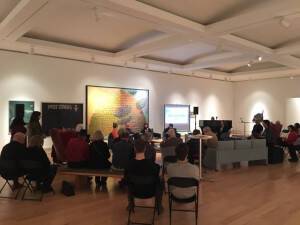
16837728_10154130359785706_652184353_nThe intimate event was held in the Isabel McLaughlin Gallery, transformed into a cozy living room with comfortable chairs, sofas and ottomans, against a stunning backdrop of works by local artists.

People shared their memories of the RMG in what CEO Donna Raetsen-Kemp described as “a casual evening of sharing stories.” There were laughs, many nods of agreement and even some surprises throughout the evening.

Elizabeth Sweeney, manager of public programs, got things started with a brief history of the RMG. The regional gallery, which contains the largest collection of the Painters 11 in Canada, had humble beginnings in 1967 in a commercial space on Simcoe Street South, the site of an exhibit by local artists organized by Oshawa designer William Caldwell.

Donald Dodds, former member of the gallery board, practised law in the same building as Caldwell’s office.

“I can remember when he decided that something should be done about an art gallery in Oshawa,” he said.

He added Caldwell shut down his office for months in order to work on creating the first gallery.

“It was really, really a dear little gallery.”

The artistic enterprise got the support of artist Alexandra Luke and her husband, Ewart McLaughlin, grandson of Robert McLaughlin, founder of the McLaughlin Carriage Works.

The original gallery was built on the side of the Oshawa Creek, set back between City Hall and the McLaughlin branch of Oshawa Public Libraries, in 1969 and named for Robert McLaughlin.

Local artist and long-time volunteer Jane Dixon said Caldwell had gone into the Art Gallery of Ontario for advice on building a gallery in Oshawa. He was told the best way of doing this was from the top down, not the bottom up as the Oshawa group was doing, she said. They ignored this.

“They were real pioneers and fought for something they believed in,” she said.

Noted Canadian architect, Arthur Erickson, expanded the building in 1987 with a design that “enveloped” the original building, the RMG’s Senior curator, Linda Jansma said.

Sweeney talked about “the two key women” in the RMG’s development, Luke, a member of the Painters Eleven, and Isabel McLaughlin, a modernist artist and daughter of Robert’s son, R.S. “Col. Sam” McLaughlin. Both artists provided support in terms of funds and donations of art from their private collections.

The gallery took its cue from Luke and built its permanent collection around abstract art.

Jansma remembered visiting the gallery when she was an art history student. She was doing a paper on the Painters 11 and wanted to photograph the art. The preparator at the time obliged “and took them out and put them in the backyard so I could photograph them.”
16923984_10154130358405706_18791538_nArtist Sean McQuay, who worked at the gallery as associate installer and evening security guard after high school, remembers a Painters Eleven artist attending to help install his works for a major exhibit but being dissatisfied with the results.

The artist came back the next day with his oil paints and “fixed” his paintings, McQuay said.

“Joan (Murray, director at the time) didn’t know what to do. We were shocked. By the time he left, he had altered them,” McQuay said.

Dedicated volunteers helped the RMG, said Dixon. She spoke of the “many, many schemes” the volunteers came up with to raise funds, including Art Mart, a popular arts and crafts sale, fashion shows, auctions and lunches.

“We all became good friends, the volunteers.”

Volunteers continue to help support the RMG, providing thousands of hours of service and running the Gift Shop.

Those attending RMG Rewind also ventured into the dark side, watching a film about reports of ghosts in the gallery.

“The place is haunted,” McQuay said.

While he worked in the original building, he refrained from using one staircase on his security rounds because “I’m positive there was a spirit in the corner.”

On that note, Gordon Dowsley said a group came to the board about 10 years ago, explaining the feng shui of the gallery “was out of whack.” The group suggested jacking up the building and rotating it 90 degrees, he said.

“They couldn’t understand the directors’ reluctance to jack the building up and rotate it,” he said to laughter.

Over the years, the RMG has grown to include a permanent collection of more than 4,500 works, with changing contemporary and historic exhibits in five galleries, a collection of historic photographs of Oshawa and area, an education program and popular cultural events such as RMG Fridays.

Join us on June 25th as we celebrate the gallery’s 50th birthday at our Strawberry Social Birthday Party. Stay tuned for event details!

Christy Chase is a long-time resident of Oshawa, a writer, and former reporter and editor with local newspapers. She now enjoys exploring her artistic side at the RMG.
Art Lights My Fire – what exhibiting artists think of artmaking

In preparation of Durham Reach, we asked exhibiting artists to submit quotes that inspire them, resonate with them, or get their creative juices flowing. Here’s what we got back:


Ingrid Ruthig
“From fragments, we continue to rebuild the story of ourselves.”
“Imagine us in this incomplete story with the unknowable end.”
“Each generation should ask, What will you know of us?”

Jay Dart
“Take time fer ponderin’
and keep on wanderin’.

While the ponderers ponder
and the wonderers wonder,
the wanderers wander
and the plunderers plunder.”

Laura M. Hair
“Boundaries fade, dimensions alter and identities merge”

Edward Falkenberg
“Art Lights My Fire”
(A riff on the song from the 80’s Baby you Light my Fire.)

Karolina Baker
“When themes start showing up in artwork, take note…artists are like canaries in the coal mines.”
“Art that creates a conversation of any sort has served its purpose”

Olexander Wlasenko
“We see images through images we’ve already seen.”

Ruth Latimer
“When making art, always be a beginner.”

Jay McCarten
“I am continually humbled by nature”
“Nature is bigger than our human experience ”
“Within a seemingly indiscriminate collision of forms, a long established and powerful system of order emerges.”

Dani Crosby
“Evidence of the invisible.”

Judith Tinkl
TRA TAR RAT – you have to look!
tra tar rat – you have to look!

Jeff Morrison
“If inspiration is water, pray for rain”

Wes Peel
“Simply make meaning of the world in which you live.”
“Art is fuelled by both aspirations of grandeur and the mundane details of life.”

Sean McQuay
“If you walk around and around in circles, you circle and circle around.”
“I equate art making to hill walking; the more vigorous the climb the more rewarding the view.”
“If you don’t know what it is it must be art”.

Photos worth more than 1000 words – The Thomas Bouckley Collection

By: Raechel Bonomo

There is a rich sense of history behind the photographs in the Thomas Bouckley Collection. Each work freezes a moment in time that captures the unique history of Oshawa and how the city is constantly changing.

vintage photo

Cedar Dale Hockey Team, c. 1925

From historic buildings to events that shaped Oshawa, this collection comprises of photographs taken by Bouckley, photos from his father’s collection and found photographs, in addition in recent years there has been many donations from the community to the Thomas Bouckley Collection. Like Bouckley himself, they all wanted to preserve this history and by contributing their personal photographs they’ve done just that.

Thomas Llewellyn Bouckley was born in Blackpool, England, in 1904 to Aubrey Llewellyn (Mike) Bouckley and Elizabeth Moss, Thomas Bouckley came to Oshawa with his family as an infant. The Bouckley’s immersed themselves in the history of their new home, specifically the in the oral history of Oshawa. Thomas Bouckley began to develop an extensive level of expertise about Oshawa and the surrounding area and was an early member of the Oshawa Historical Society.

This reputation led Bouckley into assisting historian Leslie Frost in uncovering Oshawa’s connection with the Scugog Carrying Place.

The Scugog Carrying Place was a set of paths used by Aboriginal peoples and early settlers to travel around Durham Region. These paths are considered to be the foundation for Oshawa and neighbouring cities and towns.

Bouckley speculated a French trading post where Benjamin Wilson, the first known settler in Oshawa, resided in was actually Cabane de Plomb, a known part of the Scugog Carrying Place. This post was located 150 yards east from Oshawa Pioneer Cemetery in what is now known as Whitby.

Rum Running During Prohibition, 1920

Rum Running During Prohibition, The Thomas Bouckley Collection, The Robert McLaughlin Gallery

Through the power of oral history and photography, Bouckley continued to help tell the story of Oshawa. Like his father, he began photographing Oshawa in order to preserve the city he knew and loved. This passion for history and storytelling is what lead to what we now know as the Thomas Bouckley Collection.

Originating from Bouckley’s deep admiration for his father’s photographs depicting scenes, people and infrastructure from Oshawa’s past this array of work has grown from telling one man’s story to telling an entire city’s.

The Thomas Bouckley Collection was gifted to the Robert McLaughlin Gallery in 1985, three years before Bouckley’s death at age 84, and sits at more than 4000 photographs. The RMG continues to tell Bouckley’s account of Oshawa then to now and maintains his legacy by collecting images from the city’s bustling past. From WWI to the opening of the beloved Wilson Furniture, which is still in business today, each photo in Bouckley’s collection tells well over it’s 1000 words worth of history.

Raechel Bonomo is a writer and Oshawa-native. As a journalism-grad, Raechel looks to tell stories in various forms about various topics. Her lifelong love affair with art fuels her freelance writing but, by day, she works as the editorial coordinator for a conservation organization.

In her free time, she can be found either wielding a paintbrush or trekking through the unbeaten path in a forest somewhere in southern Ontario.